

PMDD, Medusa, menstruation and monsters: ‘Periodic Bitch’
By: Emma Hardy
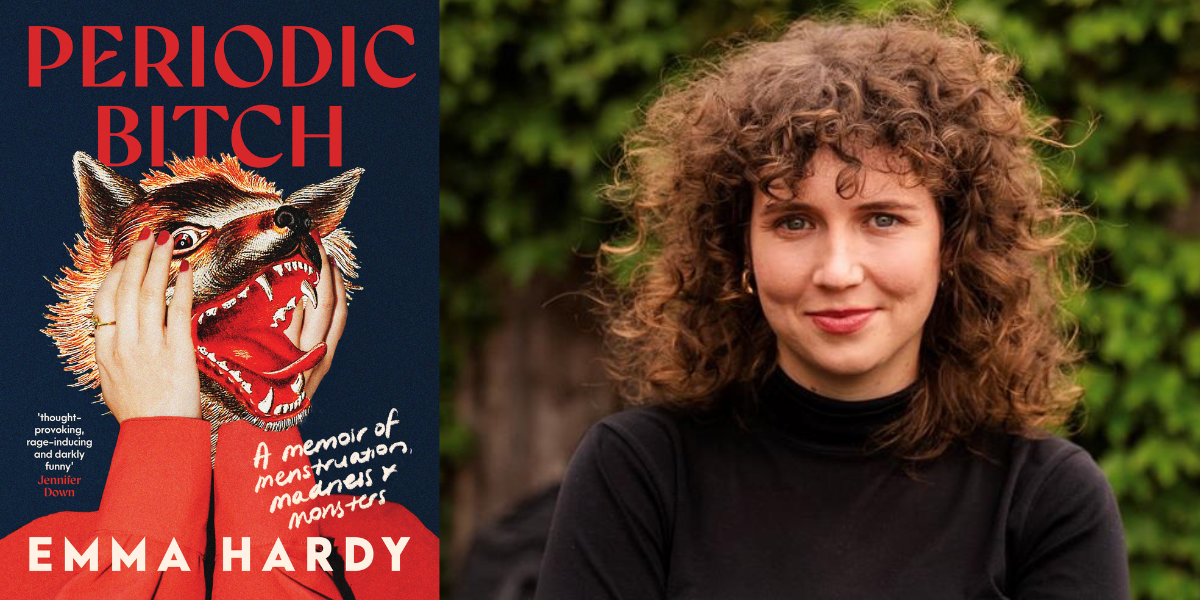
The following is an edited excerpt from Periodic Bitch by Emma Hardy. Emmy Hardy appears at the Melbourne Writers Festival from 7-10 May. Tickets available via mwf.com.au.
Periodic Bitch is available to purchase now.
Content note: This excerpt discusses PMDD and mentions sexual assault.
Author headshot: Simon McCulloch
I’m in that phase of my cycle and I’m telling Pavan that we need to break up.
‘Is this the PMDD thing?’ he asks. I feel restless, anxious, like something—anything—needs to change, and that breaking up might just be the answer. The answer to what, I’m unsure.
‘Just because I’m upset doesn’t mean it’s my period,’ I say. ‘Don’t use that against me.’
Pavan holds his hands in front of him as though trying to calm a bull.
‘Okay, okay,’ he says. ‘I’m just trying to understand.’
When my period comes three days later, I’m too embarrassed to feel relief. It’s so obvious, and yet I am still so bad at recognising it. I begin to think of myself as a monster. Untrusting of my own memories and experiences, I fill the empty parts with fear and fantasy. I feel that I am getting worse.
Whenever I start to think seriously about premenstrual illness, I get distracted by an evil to carry. I become obsessed with female monsters, with how coming of age can be a metaphor for becoming evil.
At fifteen, a few months before my first period, I read Stephen King’s Carrie (1974). For Carrie, a teenage misfit in an abusive home, the onset of puberty unleashes telekinetic powers. Her mother, who never taught Carrie about menstruation, calls it ‘the Curse of Blood’.
Brian De Palma’s 1976 film adaptation begins with slow-motion pans of young female bodies in a women’s change room, scored by dreamy strings. Carrie is in the shower. She looks euphoric, almost orgasmic. Then she notices the blood. It’s between her legs, dripping down her thighs. Euphoria ends. Panic sets in.
‘Am I dying?’ a terrified Carrie asks her gym teacher.
The mood echoes the famous shower scene in Alfred Hitchcock’s 1960 film, Psycho: another tableau in which blissful solitude ends in horror.
Here, the camera follows the blood as it runs down Carrie’s legs and towards the drain. At the end of the scene, a light bulb flashes and breaks, and we hear two sharp notes, evocative of Psycho’s piercing, stabbing tones.
But this time there is no shadow outside the shower. There is no external monster. The monster is inside the shower: inside Carrie.
The connection between blood and Carrie’s telekinesis returns in the climax of the film.
Carrie is crowned prom queen, but, once again, her joy is short-lived: when she’s onstage accepting her title, her classmates douse her in pigs’ blood.
Humiliated, her powers grow forceful and frenzied, fuelled by rage. Her mother’s voice ringing in her head, she annihilates everyone in the room—those who helped her and those who tormented her alike.
She appears to be in a near-dissociative state, watching the world around her burn. Her rage is a product of her environment, but it’s internal, too. Her display of anger seems half knowing revenge, half a loss of control.
In Monster Theory, Jeffrey Jerome Cohen posits that the creation of monsters is a way of policing behaviour within a society, ensuring that people do not defy cultural norms.
What our culture views as a monstrosity shows us where the borders of polite society are, and what might happen if we dared to cross them. Betraying cultural expectations—be that by being too loud, too angry, too gay, too messy, or too different—can mean leaving the boundaries of what’s culturally acceptable and entering the territory of the monster. It is to move beyond cultural reason, and ‘risk attack by some monstrous border patrol or (worse) to become monstrous oneself’.
Horror narratives then act as warnings: become too much, defy mainstream expectations, and risk becoming either a victim or a monster.
I think back to Carrie. To her mother, Carrie becomes monstrous the moment she gets her period. Becoming an adult is a transgression of childhood: a transgression of innocence. Yet to the audience, Carrie is monstrous only at the end of the film.
Her real monstrosity is not her coming into adulthood, but her transgression of feminine ideals: her coming into rage.
There is more than one way to look at a monster.
In Ovid’s telling of the story of Medusa, the Gorgon was once a beautiful woman with lovely hair. She only became a monster after she was raped by Poseidon. Then her hair turned to snakes; direct eye contact turned men to stone.
Put differently, her pain was so great that no one could bear to look at her. She was monstrous because she felt too much.
Another of the Greek behemoths, Charybdis, was once a lusty, loud-mouthed woman.
Zeus believed that she was stealing from him, so he chained her to the bottom of the ocean, where she would devour anything and everything in her path. She was cursed to become a voracious whirlpool. Her hunger could swell the tides. She wanted too much.
It’s through these interpretations that I start to question my own biases and preconceptions: what is a monster, and who decides it is monstrous?
Carrie’s ability to transgress the cultural expectations of women as restrained—meek—is as enviable as it is fearsome. The horror is that in her revenge she hurts not only those who hurt her, but those who tried to help her, too. At the same time as I am horrified by her power, by her violence, I feel some sick admiration for her boundlessness, for the power she holds through her anger.
Perhaps becoming a monster is not an inevitable ending, but a flash of power in an otherwise hopeless story.
Jess Zimmerman is an American writer whose work often explores gendered myths. In her book Women and Other Monsters, Zimmerman is careful to remind us that most stories of monstrous women are stories told by men.
From another viewpoint, these women are not monsters, but fleshy, angry, ambitious, desirous beings. Perhaps, were the stories written by these monstrous women, their narratives would feel less terrifying and more whole.
I see this same lack in other literature too: many of the resources I find about premenstrual illnesses are medical, scientific texts written often by men—in disembodied and abstract ways. The illness is not lived in, but observed. I find the story told in these texts all the more distant, and at times useless, for it.
I think of the essay ‘The Laugh of the Medusa’, in which feminist critic Hélène Cixous writes, ‘I wished that [women] would write . . . so that other women, other unacknowledged sovereigns, might exclaim: I, too, overflow; my desires have invented new desires, my body knows unheard-of songs.’
Cixous writes of women who have learned to be ashamed of their strength, of their bodies and of their voices. She asks that women write not alongside these myths of monstrous women, but through and away from and despite them, that we write not because writing is good, but because, compared with these ancient stories of unspeakable horrors, it is new. There is immense possibility when, instead of writing reasonably, we write without reason.
‘You only have to look at the Medusa straight on to see her. And she’s not deadly. She’s beautiful and she’s laughing,’ writes Cixous.
Perhaps a monster is just a body, or just a woman, and there are other stories we can tell.
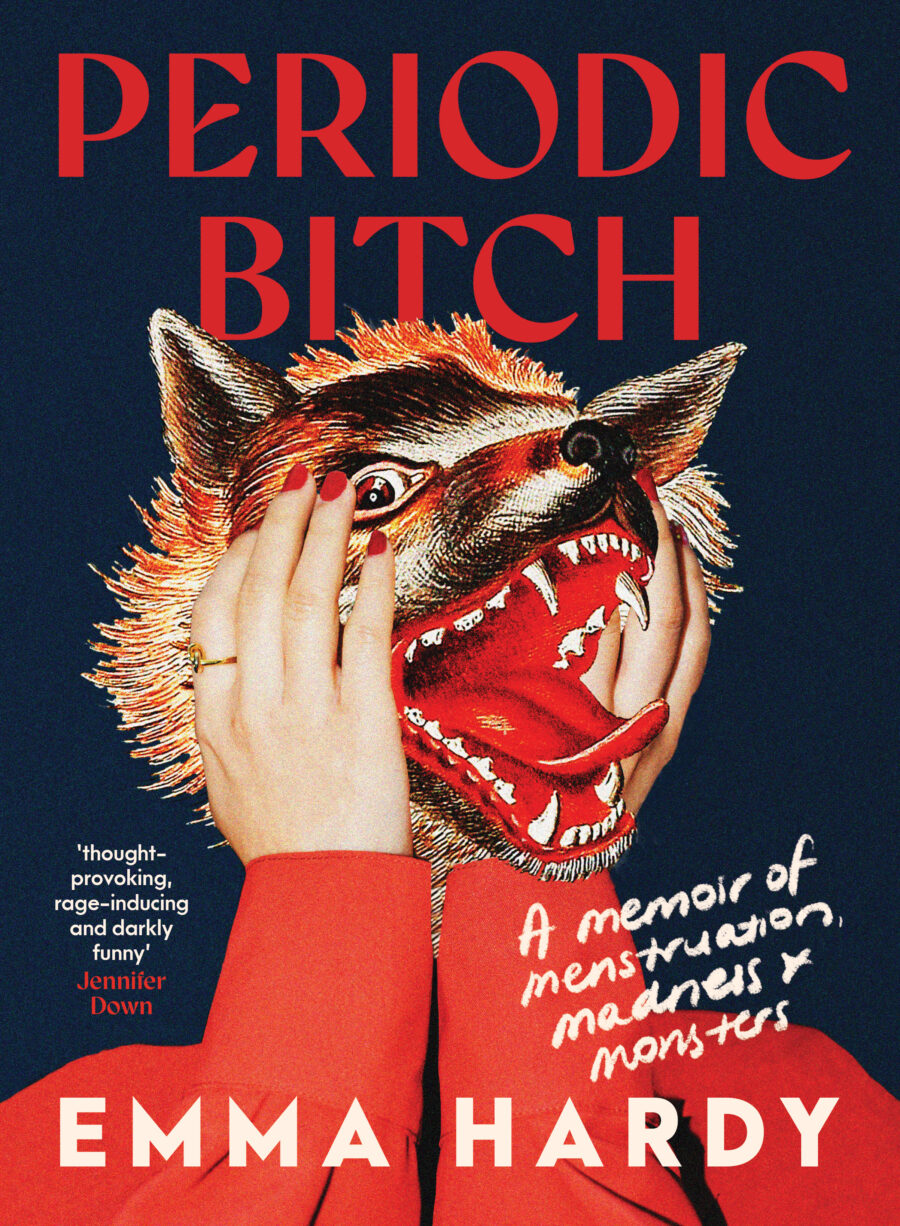
Periodic Bitch by Emma Hardy is available now.