

Archer Asks: Author Bobuq Sayed on border violence, queer diaspora and liberation
By: Alex Creece
Advertisement
Content warning: This interview briefly discusses sexual violence.
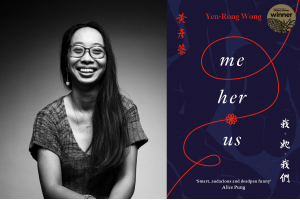
Bobuq Sayed is a writer, organiser and performance artist. Born in Perth to Afghan refugee parents, they have lived in Melbourne, the Virginian suburbs of Washington DC, Istanbul, Miami, Berlin and, most recently, New York City. They are a graduate of the University of Miami MFA program in Fiction, where they were a James A. Michener Fellow and won the Irene Pines Award.
No God But Us is Bobuq’s first novel. In this seductive, provocative debut, two Afghan men – cast out of their respective countries of birth by circumstances beyond their control – collide in Istanbul, a city that will test their willingness to sacrifice everything for the ones they love.
No God But Us is out now and available through Hardie Grant and in bookstores.
In this interview, I chatted to Bobuq Sayed about queerness and refugee status, trans ‘eggs’ in diasporic communities, Pride as a protest and anti-imperialism.
Author headshot: Guang Xu
Alex Creece: Hey Bobuq, congratulations on your stunning debut book! You used to be an editor at Archer, and it’s so lovely to see all you’ve achieved since then! Sending big love from the whole team.
Firstly, I wanted to acknowledge the timely significance of No God But Us, which is embedded in the politics and resistance of marginalised folks, particularly right now, when Israel’s genocide in Gaza continues and escalates to Lebanon, and the US-Israeli powers wage war in Iran. And of course, your lived experience and positionality as an Afghan author feels close to the heart of this book.
If you’re comfortable, is there anything you’d like to share with readers about how this book speaks to the world at this current moment, and the interconnectedness of liberatory struggles?
Bobuq Sayed: Thank you! It’s wild being on this side of the interview now!
Yeah, the book is really timely, which is unfortunate, because I started writing it in 2020, like, right at the start of the pandemic, and most of the events in the book are concentrated in 2015. It’s unfortunate that border violence and mischaracterisation of migrants and asylum seekers continues to have such strong historical resonance, you know?
In some ways, when you’re writing these things, you’re hoping to capture a time and a place that we can learn from and prevent from repeating. But you don’t think that something that now transpired 10 years ago could actually become much worse.
As far as how it relates to liberatory movements, the book chronicles how people on the margins of society take care of each other, when the government – and governments of the world – either fail to, or are complicit in, the violence they experience. At the same time, I try to convey the diverse reality and complexity of what queer and trans refugees and migrants experience, and not just some kumbaya fantasy of everyone sharing resources and taking care of each other.
Like, if we take the idea of found family seriously, then we have to reckon with how that dynamic can and does replicate the same harmful group dynamics and hierarchies as our bio families. We have a responsibility to tell the truth among ourselves about ugly emotions – like jealousy and resentment and fear – and how the injustice of the world falls unequally upon people who might otherwise espouse the principles of unity, community and togetherness. That’s more interesting to me as a writer – thinking through how, when the popular sentiment turns against certain people, as it has recently with people seeking asylum, communities turn on each other.
AC: I definitely appreciated that sort of grit – all of the characters are compelling as a reader, but no one is squeaky-clean or has a perfect little angel baby vibe that can sometimes be a pitfall in stories that want to assert our human dignity, but then end up sanitising our human lives.
BS: Totally, yeah. I think the book is an effort to defend the dignity of migration, asylum-seeking and border-crossing, with or without the law on your side, while avoiding the trap of doing so by idealising the migrant or pretending that the complex realities of human nature somehow don’t apply to them, or that they should be squeaky-clean, as you said, in order to deserve humanity, pathways to resettlement and resources to support them.
I try to convey the diverse reality and complexity of what queer and trans refugees and migrants experience, and not just some kumbaya fantasy of everyone sharing resources and taking care of each other.
AC: No God But Us focuses on the split perspectives of Delbar and Mansur, an Afghan-American (the child of Afghan refugees) and an Afghan refugee respectively. Can you tell us about the reason why you wanted to explore both perspectives in the first-person? I’m particularly interested in the way you explore class/wealth and Western influences within Delbar, and the way this differs drastically from Mansur’s life experiences.
BS: It would be much easier for me to tell Delbar’s story alone, but to only tell Delbar’s story would narrow the political ramifications of the book and inevitably characterise Delbar as a victim of the various political forces around him. Of course, there are things that happen to Delbar that suck, but I was much more interested in complicating Delbar’s positionality such that, over the course of the book, you come to realise that despite this character’s self-perception and self-narrative, the features of his American upbringing emerge increasingly as shit hits the fan. That, when really presented with adversity and high-stakes situations, Delbar’s ‘nice’ ideas about his persecuted identity and place within the diaspora really start to fall apart.
People cling to what protects them. There is a tendency for leftists to disavow their Australian nationality, or their American one, because of its colonial and white supremacist past and present. I don’t think this is necessarily right. Like, I understand the impulse. But I sort of grew frustrated in how this self-distancing can also absolve us of our responsibility to shape those nations and take an active role in in what they are doing domestically and across the world.
Saying that I have nothing to do with Australia, or that I have nothing to do with the stars and stripes or the Southern Cross, often signifies a reluctance to fight. Like oh, you abstain from electoralism and the government operations of a settler-colony? How brave of you. Now the people making decisions are consolidating power, lining their pockets, and stripping our rights. We have the nation’s blood on our hands whether or not we choose to identify with that history.
AC: Mansur’s experience of cruising as an Afghan refugee, with the heavy risks to safety, immigration status and family ties, were a compelling plot point. We don’t see many stories about cruising within the global majority, or outside of Western nations. How did you go about exploring cruising within this context and place?
BS: Yeah, I mean, it was a lot of research. I started this organisation in Australia many years ago called BridgeMeals, which I guess is the real-world analogue to PeaceMeals from the book. So, via that program, I was meeting a lot of queer and trans refugees from the global south.
Through conversations with recently arrived Iranian and Afghan refugees, I started to realise how I had unwittingly absorbed a lot of stereotypes and racist misconceptions around sexuality and gender in refugee communities. We’re led to believe like, Oh my gosh, these people have suffered so greatly; they’ve had to conceal or deny themselves, and finally they arrive in Europe or Australia or America and they can be themselves. And that’s just not true. So, I really wanted to push back on this idea that there is some latent wellspring of authentic selfhood that is just, like, lying dormant ready to be activated upon arrival in the Schengen Zone, you know?
I was reading anthropological ethnographies on cruising practices in Iran, and it was fascinating. There are several reasons why these practices are not super well-known: the first one I mentioned, which is the hegemonic idea of sexual freedom and gender expression being synonymous with the West and with whiteness, but also because revealing the local cruising practices can threaten their ability to continue in safety. So, the concealment and discretion and the subterranean existence of these sexual subcultures also serves a protective function.
That hunger for definitive knowledge is akin to the empire’s compulsion to name and categorise everything. I love that these subcultures in Iran and Afghanistan defy and reject that.
AC: Mansur also experiences a lot of sexual violence and coercion, and engages in survival sex work as a refugee. How did you go about researching and portraying these experiences authentically and sensitively?
BS: I did a lot of research, especially around Mansur, for this book. I wanted to showcase how class, visa privilege, documentation status and border violence inform the two protagonists, who broadly fall into the category of queer Afghans, but whose lives and circumstances have taken them in very different directions.
The instances of sexual violence that Mansur experiences are never directly portrayed on the page, right? They’re things that take place and that are part of his life, but I chose not to render them graphically. It wasn’t clear to me what function it would serve or for whose benefit. It felt important for me to explore privilege within bodily autonomy and access. Who has the luxury to choose love? And whose circumstances engineer security into the choices they make? It was impossible for me to be talking about love and migration and not acknowledge the role of bodily autonomy and sexual violence. Migration transforms people. Every border takes something out of the migrant and, simultaneously, it instils something in them too, for better or for worse.
I really wanted to spend as little time on the page explicitly portraying the act of sexual violence because I didn’t want to personify it in any singular body; it was essential for me to account for it as a system of violence that is connected to the system of violence generated by borders, right? We can’t think about rape and sexual violence as separate from other systems of violence.
Who has the luxury to choose love? And whose circumstances engineer security into the choices they make? It was impossible for me to be talking about love and migration and not acknowledge the role of bodily autonomy and sexual violence.
AC: I’m going to ask a couple of questions about Delbar now. Delbar has an interesting story arc in terms of gender and identity. They are an emerging drag queen (iconically named Sharia Raw), and are suggested to be an ‘egg’ or gender-questioning / potentially trans person. What inspired these choices?
BS: So, the inspiration behind that choice was frustration with the tendency to assume transition is the most central feature of every trans person’s life. Of course, for many it is, but I wanted to consider this idea that people have whole, complete lives before they transition, as well as after they transition, and there is value to narrating that experience in its fullness.
I wanted to acknowledge how people’s questionable behaviour can often be informed by forces that they can’t really reckon with yet. Delbar’s delusionality really undergirds their entire point of view, but it doesn’t necessarily justify the decisions they make.
It was interesting to me to think about timelines of transition where diasporic and refugee communities are concerned. In my experience, often our timelines are later, or different in some other way. In that sense, migration becomes this queering of time across generations.
AC: That sentiment lends itself perfectly to my next question. So, Delbar rejects the construct of ‘the closet’, which reminded me of an Archer article on the whiteness of ‘coming out’. How does this resonate for you?
BS: I think I edited that article way back when! Yeah, I mean, ‘the closet’ is something that everyone has a different relationship with. For some people, it is very clear and unavoidable from a very early age that they will transition, no matter what and no matter who tells them not to. Fab! Go off, sis. There are also some people who know they’re trans but will never transition or allow that part of themselves to emerge. Then there’s also just like another whole spectrum of different relationships to transness – to incubating or ignoring or harbouring ‘egg’ tendencies.
I’m a writer of fiction so, of course, the grey area is interesting to me: the contradictions that come with being alive, educated, urban and privileged, alongside the tensions of identity. How do trans people subtly, and maybe at times unintentionally, induce the cracking of their eggs?
AC: Pride is a true protest in this book – and a site of authoritarian violence and police brutality where Anahita, a trans woman of colour and refugee, is the most severely affected of the main characters. Can you speak to the significance of writing about Pride away from a whitewashed/pinkwashed corporate-pilled lens, and in demonstrating the disproportionate harms of government on multiply-marginalised LGBTQIA+ people?
BS: Yeah, for sure. I mean, it was living in Turkey in 2015 that really opened my eyes to this phenomenon. Delbar dismisses the rainbow flag as a completely co-opted symbol of rainbow capitalism ala Sydney Mardi Gras’s Absolut Vodka branding. This was sort of my perspective on the rainbow flag, too; I felt a total disinvestment, that it had been fully defanged, right? But in places like Turkey and Egypt, I saw how much the flag means to people, and how much it angers police. I mean, Sarah Hegazy was imprisoned and brutalised for displaying a rainbow flag at a Mashrou’ Leila concert in Cairo. It’s the same flag but, in a way, the context means it’s not.
It feels disrespectful for me now to speak in generalised terms about what the rainbow flag is and isn’t after that experience, because it has its own meanings and significance in the global south, and especially in Muslim-majority countries, where corporate co-optation is not really the issue facing queer people. So, I wanted to convey some of that complexity. The flag doesn’t belong to Absolut Vodka; no matter how big the billboard is. That flag is ours and it belongs to the streets and the queers who find ways to live their genders and sexualities everywhere in the world.
Nowadays, I find myself quite upset when people are totalising or reductive about the rainbow flag, because that doesn’t account for the reality of people who are really invisibilised, and protest movements that are resolutely suppressed. If we paint the Mardi Gras version of the flag as the only truth, then we’re complicit in the erasure of these other fugitive histories.
The flip side of this is that the rainbow flag has a tendency to flatten and homogenise differences within our community informed by gender, class, native-English proficiency, documentation and HIV status. I wanted to showcase how these differences play out, rather than the rose-tinted idea that ‘love will save the day’ or ‘we’re all the same colour’ or whatever.
If we paint the Mardi Gras version of the flag as the only truth, then we’re complicit in the erasure of these other fugitive histories.
AC: To quote Mansur:
“You don’t ask permission to belong to your home. If the taps are leaking or your clothes are covered in dust, something is wrong with the house. It must be repaired. Delbarem, a hundred empires have come and tried to fix Afghanistan. A hundred false gods. The Mughals and the British and the Soviets and the Taliban and the Americans. No one will fix it but us.”
What can this book teach readers about the concept of home and homelands, especially as it relates to Indigenous sovereignty (including the Kurdish people)?
BS: I can’t help but think of the despair I’m seeing in my communities, which is driving some Iranian people to espouse this plea of: Won’t someone come help us? America, why won’t you help us? I get the impulse but it’s actually this language that manufactures consent for foreign intervention and imperialist aggression that, historically, is shown to set people back by decades. I mean, you only have to look at Afghanistan to see a case study of that same logic. Women and girls are worse off under Taliban 2.0 than they were back in the ’90s.
So, I think I was trying to emphasise and articulate an anti-imperialist position. Anytime there has been an improvement in the lives of people, it happens because of an organised struggle by working people, and organic change over time. I wanted to convey some of that nuance.
I was interested in illustrating the Kurdish struggle, partly to educate about the Turkish occupation of Kurdistan, and partly as an analogue for the Palestinian struggle against the Israeli occupation. The power dynamics between Kurds and Turks is also fascinating to me because it’s brown-on-brown violence. It’s easy to condemn Bob Katter or Pauline Hanson for white supremacy, but how does their political rhetoric show up in our own communities? What are the deeper social and economic forces underlying their rise? This is more interesting to me. I wanted to convey how power struggles against oppressors don’t always fit neatly into black-and-white binaries; there’s a lot more we can learn from what we’re complicit in.
AC: Thank you for all of these terrific responses. Is there anything else on your mind that you’d like readers to take away from the book?
BS: You know, I think the only thing I’m going to say is that it can be easy for an Australian reader – as an Australian myself – to read this book about an Afghan-American and distance themselves from the narcissism and ego attributed to Delbar’s American upbringing. Australians love to do that, right? Like, Oh my god, America’s so racist, so right-wing. I don’t know how you live there, it’s so unsafe, it’s so fucked, there’s Trump, there’s guns.
I want to caution Australian readers from doing that. There might not be any explicit reference to Australia in this book, but to my dear, beloved Australians: this book is also about us. You can find the trace of Australian travellers in every hostel in the world. We backpack and we assume a sense of bravado and impartiality, and we think because we’re not American or European that we’re somehow excused from self-reflection or critique. But our conscience isn’t clean either.
Thanks for the interview, Alex – I really appreciate it. I used to be the one on the other side of this call, but now I’m the one you interview! That’s crazy! Please give my love to the Archer team, too.
There might not be any explicit reference to Australia in this book, but to my dear, beloved Australians: this book is also about us.
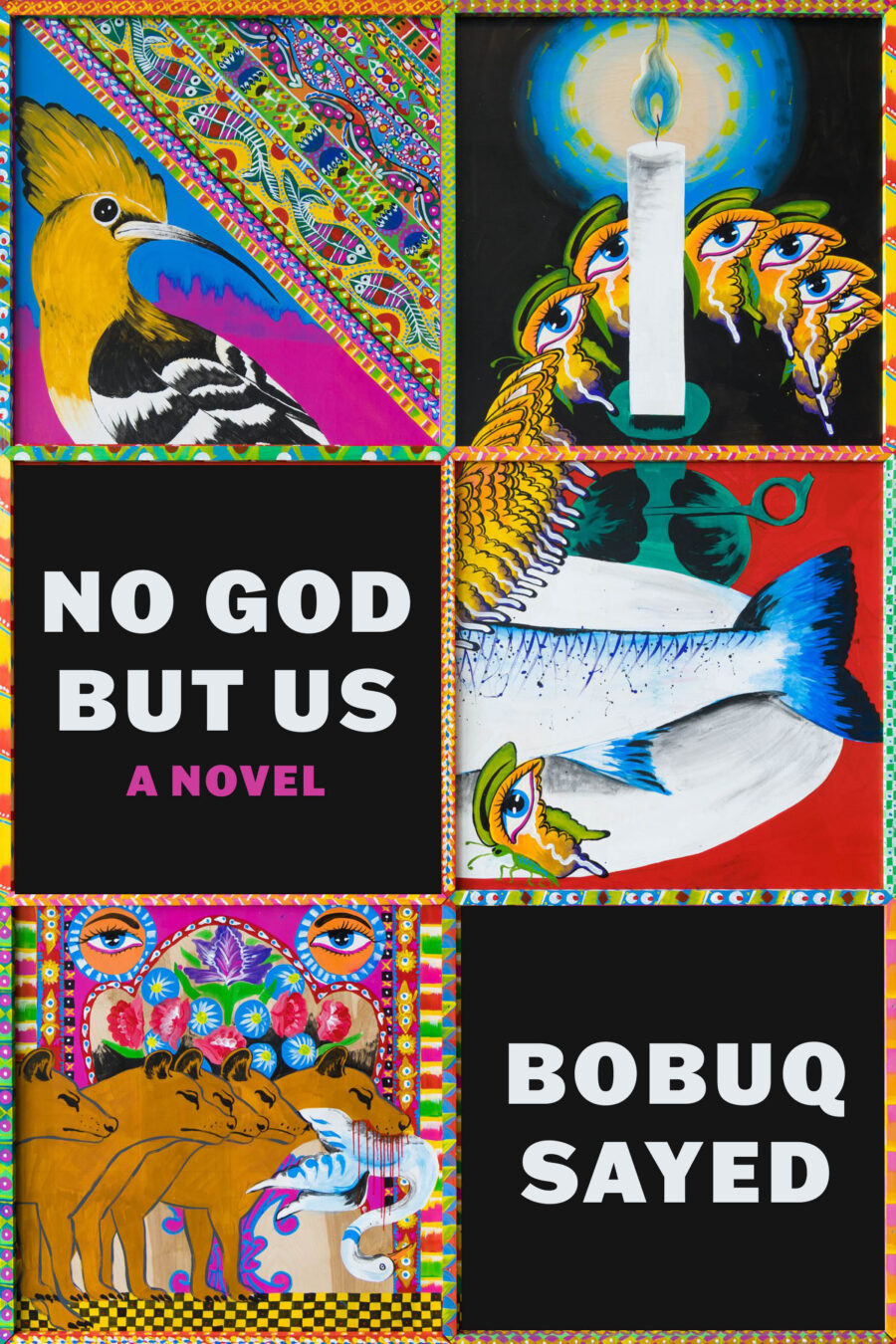
No God But Us is out now and available through Hardie Grant and in bookstores.