

Badass female video game characters for the gays: Playing like a girl
By: T. L. Jones
During lockdown, I developed a post-work habit that ocassionally raised eyebrows – and sometimes still does.
Where some turned to baking, wine or sourdough as their stress relief, I turned to the panacea of video games. Well, one game in particular: Super Smash Bros.
For the uninitiated, Super Smash Bros is a platform fighting game where the goal is to knock your opponent off a floating stage and into the proverbial “blast zone” just beyond the edges of the screen. The more damage your opponent takes, the further they fly – until they explode in a conflagration of light and confetti.
It’s addictive fun: with every obliterated opponent, adrenaline sluices through the body like quicksilver.
My Smash character of choice is Princess Zelda, the titular princess of the Legend of Zelda series.
Unlike in her own franchise where she is often relegated to an NPC (non-playable character) damsel in distress, in Smash, Zelda is a playable powerhouse who’s more than capable of saving her own bacon without Link’s help.
She can conjure a fireball at her fingertips. She can summon a ghostly, purple knight to do her bidding. Her best move – a lightning kick delivered by her heeled, open-toe boots (work, queen!) – is active for only a single frame. When you land that move’s sweet spot, delivering that stiletto-heeled kick into the belly of your opponent, there is no greater satisfaction.
She’s a high-risk, high-reward character who incentivises patience and strategy. (She doesn’t have the unstoppable Tri-Force of Wisdom for nothing!)
One night, just as I had launched Ganondorf into the blast zone with a well-placed lightning kick, my boyfriend asked, “Why do you play Zelda?”
I replied, a little defensively, “Why not?”
It’s no secret that in Smash land, Zelda is considered a ‘low tier’ character. She’s slower than the majority of the roster, which means she struggles to find an offensive opening and is quickly overwhelmed by faster opponents. Plus, in a video game where the objective is to launch your opponent offstage, her Mary Poppins floatiness gives her an exploitable disadvantage.
As a result, she cops a lot of misogynistic hate online from (young, male) players who choose more macho characters like Donkey Kong, Fox and Kazuya.
But my boyfriend couldn’t have known that. He’s barely played the game, let alone interacted with the online anti-Zelda rhetoric. So why was I being so defensive?
And then, it hit me: instead of the innocent question he had asked, I heard a more pointed one – one that I’d heard whenever I played a video game as a child: “Why do you always pick the girl characters?”
In Smash, Zelda is a playable powerhouse who’s more than capable of saving her own bacon without Link’s help.
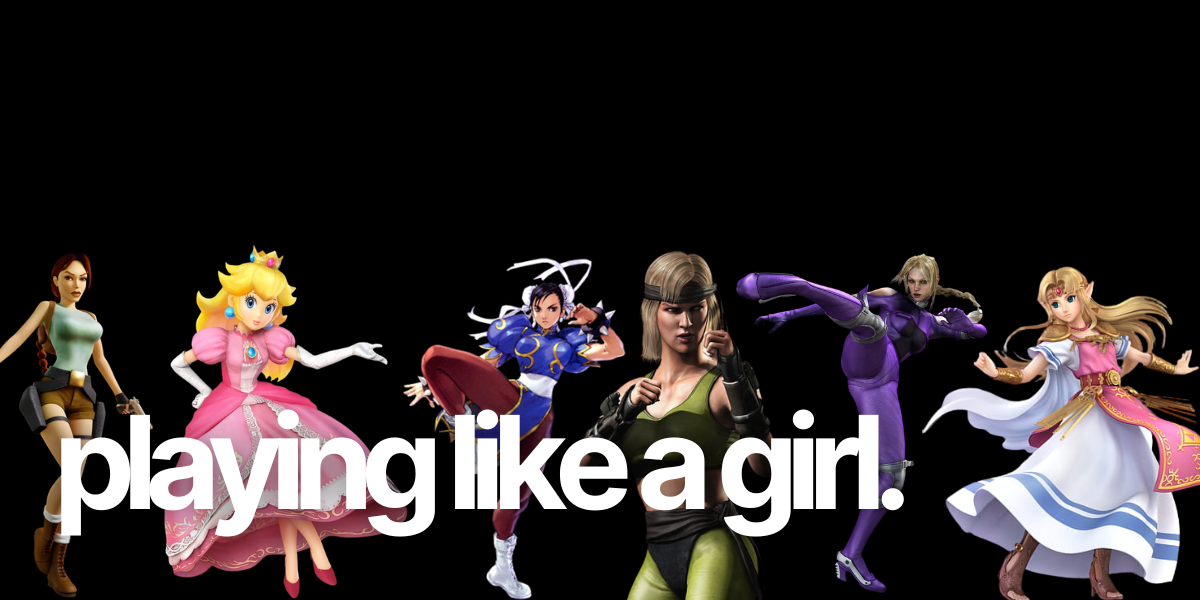
Princess Peach. Chun Li. Sonya Blade. Xenia Onatopp.
Each of these video game divas drew me in as a young gay boy. But why? Doubtlessly, it wasn’t sexual attraction – there were plenty of handsome (and shirtless) male characters for a nascent homosexual to choose from: Ryu with his open-chested tunic; the J-Pop good looks of Jin Kazama; the meme-worthy bubble-butt of Solid Snake.
So what was it about these digital divas that enraptured my little gay mind – and over a smorgasbord of hunks no less?
In an article for The Guardian about unexpected queer icons, Jason Okundaye writes that when a boy of the “lavender persuasion” only picks female characters, “the parents might think it’s because he fancies them, but really it’s a form of diva worship.”
Diva worship refers to the way gay men idolise female stars – it’s a relationship created and encoded by ideas of camp.
In The Cinema of Camp (1978), Jack Babuscio writes that because gays and lesbians do not conform to conventional behaviours of straight, cisgender men and women, their heightened awareness of the performance of societal roles can lead to an “appreciation for disguise, impersonation [and] the projection of personality”.
This attracts us to “certain stars whose performances are highly charged with exaggerated (usually sexual) role playing”. Though Bubuscio is writing about 20th century cinema, we can certainly extend his argument into the realm of video games.
So what was it about these digital divas that enraptured my little gay mind – and over a smorgasbord of hunks no less?
Okundaye’s camp diva of choice is Nina Williams, the balletic fighter from the Tekken series, who slaps and jabs with “rhythmic, pirouetting gracefulness”.
Certainly, there is something very camp about a beautiful woman killing men twice her size through dance-like combat – sometimes in a full wedding dress.
For me, this exaggerated performance is encapsulated by the hypersexual Xenia Onnotop of GoldenEye 64, who kills men by literally squeezing the life out of them between her thighs. And don’t even get me started on Chun-Li’s side-splitting qipao and ox-horn hairstyle.
Likewise, there is something decidedly camp about Princess Zelda’s open-toed and stiletto-heeled boots – preposterous (albeit fabulous!) footwear for the battlefield.
While diva worship was doubtlessly part of my attraction to these powerful female video game characters during my youth, there was also something much deeper than mere idolisation at play.
In his 2023 essay ‘Challenging the stability of gender, sex and sexuality in video games’, Marc Ouellette argues that the act of play can be a site for queer exploration. Video games, he writes, offer “more than just interactive versions of representations”. They also offer the player an “entry point” to practise, rehearse, prepare and repeat roles that challenge traditional expressions of sex, gender and sexuality.
This, I would argue, is the true value of what these video game divas offered me: a way of exploring my femininity that was vital to navigating my adolescence.
Certainly, there is something very camp about a beautiful woman killing men twice her size through dance-like combat – sometimes in a full wedding dress.
As an effeminate gay boy, I was often mistaken for a girl because of the way I moved, the way I spoke and the way I wore my hair.
My femininity was a source of shame – one that was readily ridiculed by the other boys my age. For me, the greatest insult that could be levelled was a simple one: “You’re a girl.”
But the women of video games offered a chance to reclaim the shameful feminine parts of me – and to kick ass while doing it.
For me, playing as these women was – and still is – a form of drag.
They allow me to be masculine and feminine simultaneously – and be celebrated for doing it. For even amongst those narrow-minded boys of my youth, a winner was a winner was a winner.
It didn’t matter if I played as Princess Peach in Mario Kart, or Sonya Blade in Mortal Kombat – so long as I won. (And, dear reader, I often did!)
Not only did I earn the respect of my peers, but each time my female avatar destroyed their male alter egos, they learned, point blank, the awesome power of playing “like a girl”.
This is why I always pick female characters. Perhaps I’m not addicted to the adrenaline rush of fast-paced video games, but to the sense of freedom that avatars, like Zelda, give me.
As RuPaul famously says, “We’re all born naked and the rest is drag.” But my drag doesn’t involve makeup, wigs or clothes.
I get into drag every time I pick up a Joy-Con controller.