


Translating culture and queerness: My father never said I love you, he asked what noodles I wanted
By: Alvin Quah
I remember the Friday night ritual clearly. Around nine in the evening, long after dinner had been cleared, my father would appear in the doorway and ask, quietly, what noodles we wanted. Then he would disappear around the corner and come back with takeaway from the hawker stalls – each order exactly right, each container warm.
We would eat with the kind of enthusiasm that is itself a language. He never asked whether we enjoyed it. He would sit slightly apart from us, watching, with an expression I could not have named then but can now: satisfaction. The sense of a man who had located his purpose and was fulfilling it.
He did not say I love you. He said: What do you want to eat, and I’ll go and get it.
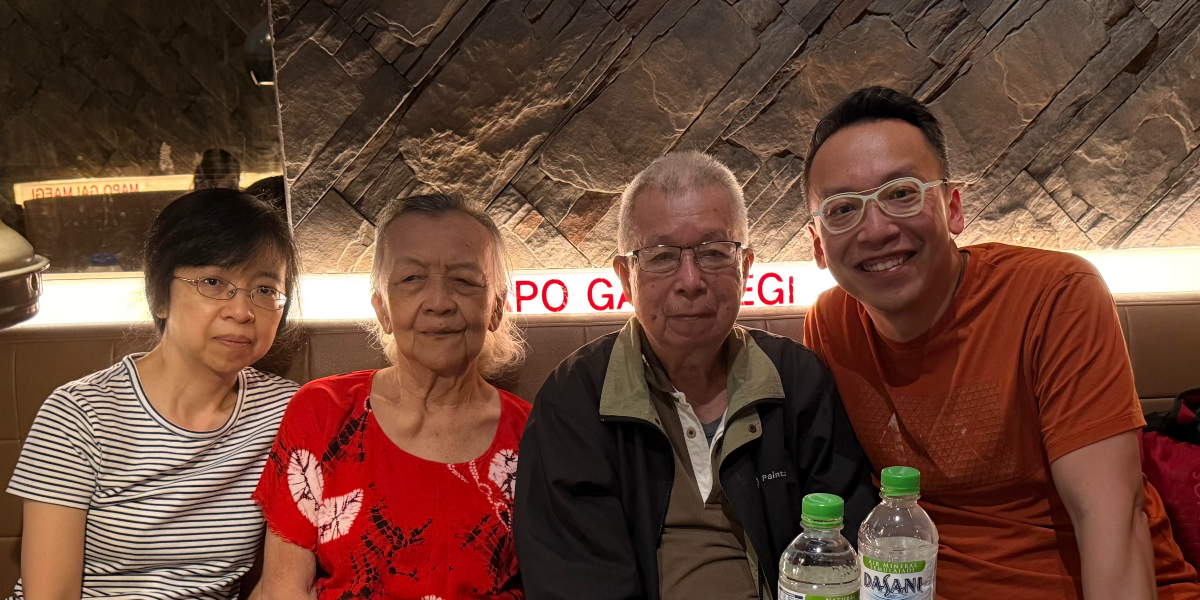
Image: Courtesy of the author
From left to right: Alvin’s sister, Alvin’s mother, Alvin’s father, Alvin.
I have spent most of my adult life translating. Between Malaysian and Australian. Between what I was raised to perform and what I actually am. Between the son my father imagined and the gay man who eventually, imperfectly, told him.
I grew up between Malaysian and Australian ways of being, which meant I grew up between two entirely different emotional grammars. In my father’s world, love was expressed through action rather than words. Happiness was not a feeling you reported; it was a condition you maintained, evidenced by stability, by provision, by the fact that no one at the table went without. You did not discuss your interior life. You managed it, and you showed up.
My mother operated differently but to the same end. She was the architect of our home, shaping the conditions for everyone else to flourish while her own needs remained largely unremarked upon. It is only in recent years that I have recognised how much of what passes for leadership – holding space, reading a room, making others feel seen – resembles what she was doing every day without recognition or title.
Between them, I absorbed a version of happiness that was relational rather than individual. It centred not on self-expression but on balance – on ensuring no one stood out too much, including yourself.
When I entered professional life, the grammar of my childhood stopped working.
Australian workplaces rewarded a specific kind of presence: speaking up; taking credit visibly; challenging the room. I remember stepping into my first sales role and being told I needed to challenge my customers, healthcare professionals, on how they were managing their patients. The clinical logic was sound. But the instruction landed in me like a small collision.
I had been raised to defer to authority, especially professional authority. To challenge a doctor felt not like salesmanship but like transgression. Nobody in the briefing room knew this translation was happening within me. It wasn’t the kind of thing the onboarding process had a field for.
For a long time, sitting in those rooms, I was rarely without things to say but saying them was another matter. What I was doing instead was calculating: a rapid, mostly unconscious arithmetic about whether this was the right moment, whether speaking would read as challenge or contribution.
I have learned, over years, to override that instinct. I challenge now, sometimes more than people expect. But I remember what it cost, early on, to do it at all and I am aware that for many people navigating the same translation, its cost has not gone down.
What one culture codes as initiative, another experiences as overstepping. What one culture calls directness, another hears as confrontation.
These are not pathologies. They are grammars. The problem is that most professional environments in the West are largely monolingual and the language they speak is one I had to learn from scratch, without anyone acknowledging there was a translation happening at all.
That pressure compounded when I came out as gay. The cultural inheritance I had been given valued restraint and conformity. Queerness, as I came to understand it, required something closer to the opposite, an active insistence on being known. I found myself navigating two kinds of code-switching simultaneously: adjusting for culture at work, and adjusting for identity almost everywhere else.
Neither felt optional. Both felt endless.
Coming out is supposed to be a singular event: a door you open. In practice, it is more like learning a new language in public, mid-sentence, while people watch. At the age of 27, I came out to friends, the ones who had already learned to hold complexity. Then to colleagues, in increments, reading rooms the way I had always read rooms, calculating.
Then to my father. That conversation was the one I had been dreading longest.
His first response was not warmth. I had not expected warmth, exactly, but I had hoped for something other than silence. What followed was a long period of distance, not cruelty, but a particular kind of careful absence. Or, the presence of a man managing something he had not been given the language for.
What I came to understand, much later, was that he had his own translation to do. He had to come out, in his way, to brothers and friends and a community with its own language for what a son was supposed to be. He had to revise the story he had been telling about his family for 30 years. That is not a small thing. His difficulty was, in its way, a mirror of mine. We were both learning to be known in ways we had not been raised for.
We got there. Slowly, not without cost, and with the particular tenderness of two people who express love through action rather than words, which meant the repair happened in accumulated small gestures before it was ever named out loud.
The week before I left Malaysia for Australia at 19 – the first in my family to go to university abroad – I lost my passport. I was desperate to leave, and the loss felt catastrophic.
In the car, on the way to get a replacement, I broke. I told my father I was sorry I had disappointed him. He was quiet for a moment. And then he reached over and patted my knee and said: “It’s okay, son. Don’t cry.”
It was the most direct thing I had ever heard him say. It was at that point I realised I had fundamentally misread him in my young life. He was not distant. He was fluent in a different register, one I had been surrounded by my entire life without knowing how to hear it.
So, I began to unlearn. Not cleanly. Not without loss. What I have come to understand is that unlearning is not the same as discarding. Some of what I was taught still holds: the ability to read a room, to choose your moments, to understand that how something is said is not separable from what is said. The question was never whether to keep those instincts, but whether I was using them as tools or as a shelter.
‘Bring your whole self to work’ is a phrase with good intentions and real limitations. For those of us shaped by multiple inheritances, it can feel less like an invitation and more like a demand – one that assumes a single, unified self is waiting behind the code-switching, like a person behind a costume.
The self, as I have found it, is not a fixed thing you uncover. It is an ongoing negotiation. The more useful question is not, “How do I show up as myself?” but, “Which parts of myself does this environment allow, reward or silence?”
Happiness is not culturally neutral. In some frameworks it is linked to individual expression and achievement. In others, harmony is the quiet satisfaction of a man who slips out at nine in the evening to bring his children exactly what they wanted from around the corner, and who sits watching them eat as if that is enough. As if that is everything.
Both of those things are true. I am still learning how to hold them at the same time.











This is exquisitely expressed, wrangling deep-rooted complexities and competing identities and only-partly-translatable grammars in heart-jumpstarting ways. Wholehearted thanks for such a tender honest open exploration.