

Craftivism: The feminist power of textile art
By: Greta Rule
My grandmother, now in her late 80s, is an incredibly talented knitter, crocheter and seamstress.
When I was a teenager, I’d tear out pages from fashion magazines my mum had finished reading and give my grandma the clippings. Weeks later, I’d receive an exact replica of the garment, handmade to perfection, with love.
Over the years, she’s made everything from dolls to blankets to little hand towels with buttons that allow you to hang them on the stove. I cherish everything she’s made me. I still have a grey cardigan she knitted, and a stuffed sheep that lives on my bed. Even now, she continues to knit for charity.
Image: Courtesy of the author
When I was around 19 or 20, my grandma offered me her sewing machine because her eyesight was fading, and a tremor in her hand made it difficult to use.
I used the machine to alter clothes I’d bought from op shops. Later, I asked if she’d teach me to crochet. It was a trending skill – I had friends who could make bags, tops and plush toys. I wanted to make a scarf for my girlfriend at the time.
And so began my textile obsession.
Later, during my studies at university, I took a storytelling unit. One assignment asked students to analyse the storytelling qualities of an artist or artwork.
I chose Judy Chicago’s The Dinner Party (1979): a groundbreaking feminist installation, first exhibited at the San Francisco Museum of Modern Art. The work features a large triangular dining table draped in an embroidered tablecloth, with 39 place settings and handcrafted plates – some with ceramic vulvas and other 3D sculptures. Each setting honours a woman from history who had been overlooked or erased. Beneath the table, 999 additional names are inscribed on the floor, creating a monumental tribute to female legacy.
There is something undeniably rebellious about installing a 48-foot table draped in a golden tablecloth, with places set for important women in history. One of the first artworks of its size and stature to showcase the relationship between feminism and art, it helped redefine the relationship between craft, storytelling and politics on an international stage.
In a review of the work published in Frontiers: A Journal of Women Studies, Anne Marie Pois noted that “utilising the ‘domestic metaphor’ of a table with place settings” on such a large scale became an ironic symbol of, and rebellion against, the constraints historically imposed on women.
In the Netflix documentary Feminists: What Were They Thinking? (2018), Judy Chicago reflected on her early career as an artist, when women were expected to “act like men” to be taken seriously. Chicago resisted this notion that undervalued and delegitimised artforms traditionally considered feminine – needlework, embroidery, knitting – reclaiming them from the margins of ‘craft’ and asserting their place in the canon of fine art.
I researched further the idea of craft as protest and how domestic labour, shaped by gender, race and class, could be reframed as art.
Traditionally ‘feminine’ creative practices (or those dominated by people who weren’t white men) have been unfairly devalued throughout history. The systemic erasure of women, queer and marginalised artists throughout history is blatantly obvious, and an ongoing lack of recognition still exists today.
I reflected on my own understanding of fibre art – how it’s so often reduced to household labour, a chore assigned to women. In the essay ‘Textiles as a Form of Feminist Dissent’ for Frieze, Lauren Elkin explores the double standards that have shaped the art world, particularly in relation to gender. She notes that, historically, “certain modes of artmaking were marginalised and feminised.”
Embroidery, for instance, “was for centuries an occupation for men and women,” yet was deemed “professional when practiced by men” and “amateur when done at home by women”.
I had never thought of my grandmother as an artist. I knew she was incredibly skilled; she could make almost anything with her hands, a needle and some thread. But in our family, the title of ‘artist’ always belonged to my grandad – her husband – who painted and drew intricate pieces that were proudly displayed in their home.
I found myself increasingly drawn to what my grandma could teach me and how it strengthened our relationship. After critically engaging with the history of craft, I realised my grandma is an artist in her own right. It made me wonder: if she hadn’t been taught that knitting and sewing were domestic chores and rather used to create textile art, what might she have allowed herself to create?
This curiosity prompted me to explore what other crafters were making, and what I found was mostly bold, politically charged feminist textile works.
Today, crafters are asserting these mediums as legitimate, powerful and professional forms of artistic expression. This reclamation of domestic artforms is a way of honouring women’s histories previously excluded from the dominant narrative. It is protesting a culture that deems craft trivial.
Kate Just, an artist based in Castlemaine, and New York artist Orly Cogan create striking, vulnerable tapestries and fibre art using knitting, embroidery, crochet and more. In an interview with Archer Magazine, Just reflected, “I started knitting and realised its powerful connection to histories of intergenerational knowledge,” and spoke of how “knitting could hold and translate a wide array of emotional experiences and narratives.”
This sent me down a rabbit hole of research into craftivism: a movement that reclaims craft as both artistic practice and political protest. Artists and activists created placards, banners, and wearable political statements out of fabric.
Take Kate Just’s 2022 work PROTEST SIGNS, a series of knitted placards bearing slogans like “Black Lives Matter” and “Protest is a Fundamental Right.” The Daily Diminish Project (2017) featured black calico banners bleached with verbatim sexist remarks experienced by Australian women, each stitched with a single red word capturing how the encounter made them feel.
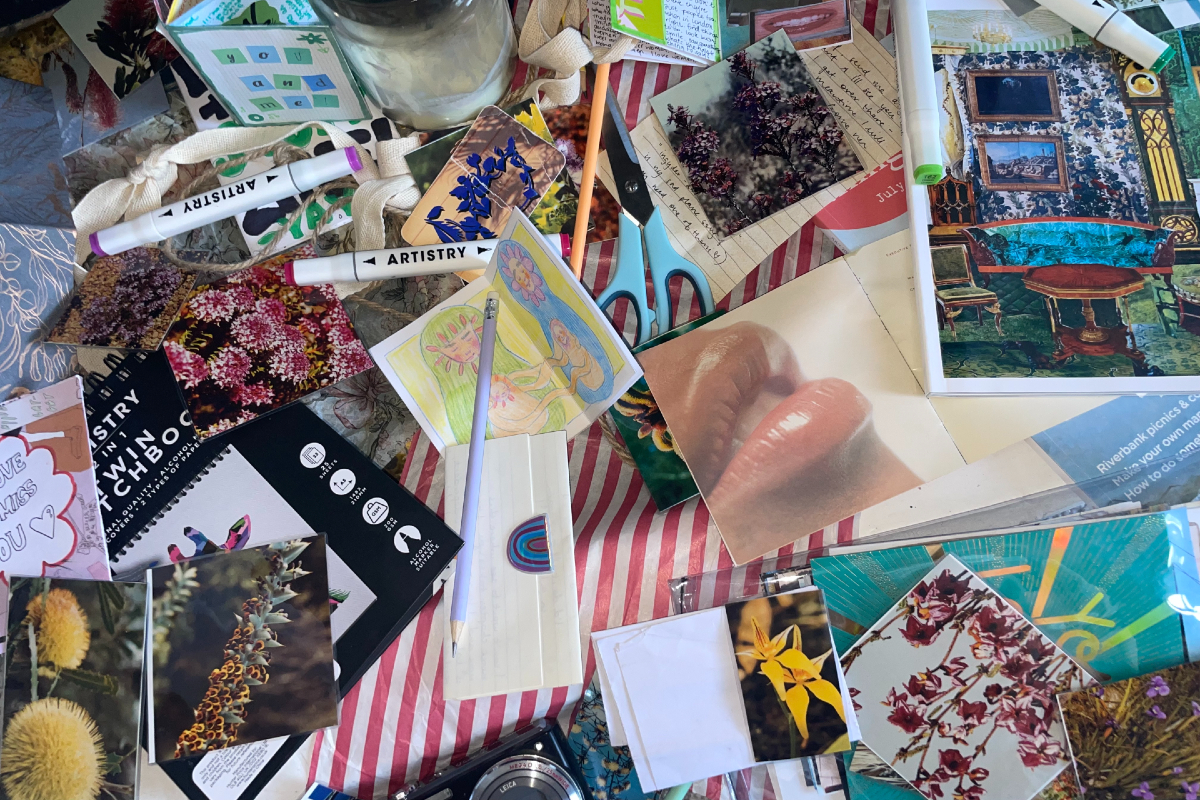
A craft night with friends could be considered protest on a smaller scale. The growing DIY trend pushes back against mass production, fast fashion and capitalist consumerism. By partaking in craft, we are choosing to consume less, waste less and reconnect with the slow act of handmaking.
Craftivism goes beyond recognising the skill embedded in traditionally feminised practices and using it to protest systemic inequality. It demands a deeper commitment to uplifting the voices of other marginalised identities, whose artistic mediums and narratives have long been sidelined, including cultural and intersectional perspectives.
There are incredible textile artists who are informed by their intersecting and unique experiences of oppression. Their specific intersections, including gender, race and sexuality, allow them to create very distinctive and personal artworks. Award-winning Argentinian artist Alexandra Kehayoglou creates large scale carpets and tapestries reflecting natural landscapes. Inspired by climate activism and using reclaimed yarn from her family’s factory, her work seeks to preserve these landscapes. She creates her semi-interactive works by weaving by hand, inspired by ancient family traditions.
Billie Zangewa is a Malawian artist living in Johannesburg who creates collage tapestries by hand-sewing raw silk fabrics. Her work explores her experiences of femininity, motherhood and her Black identity. Disabled Indian-American artist Bhavna Mehta creates striking works that aim to rescript the narrative of living with a disability. Mehta embroiders onto X-rays of her own body, a unique portrayal of a woman living with polio and in a wheelchair. Her work is influenced by folkart traditions from India.
Australian Indigenous artist Debra Beale tells narratives of Aboriginal cultural practices through textile and fashion design, among other practices. Beale is a Gamilaraay, Wonnarua, Yorta Yorta and Palawa woman who gathers natural materials from the Earth to create work that connects with culture, heritage and community.
Craftivism also honours historically undervalued artforms that are not only practiced by women.
Diedrick Brackens weaves tapestries that depict themes and perspectives from his intersecting African American and queer identity. Brackens’ work depicts images of male tenderness, labour and migration, taking inspiration from West-African, European and Southern (US) textile art. His use of cotton is a purposeful acknowledgement of its connection to slavery and colonisation.
These are just some of my favourite textile artists, but it is so important to find and engage with marginalised artists that inspire you, so they can keep doing what they do best. Plus, there are many ways to engage with art that doesn’t require spending lots of money.
Ultimately, craftivism isn’t just about celebrating craft as women’s work and honouring it for the art it is, it’s about drawing attention to the trend in culture to devalue and dismiss art made by marginalised groups. Thus, it requires a commitment to broaden our characterisation of fine art by diversifying the arts industry.
On a small scale, it starts by hosting craft nights for friends and family, appreciating their creations, or by asking your family if you can learn any textile skills that have been passed down through generations.
On a larger scale, it involves increasing visibility of artforms typically undervalued or considered ‘non-professional’. We must endeavour to include and prioritise marginalised and intersectional artists’ perspectives by acknowledging their stories and experiences, which have historically been overlooked. This doesn’t just apply to ‘feminised’ art mediums, but other mediums utilised by Indigenous peoples, people of colour, disabled people and queer and trans folks so we might recognise a range of mediums for what they are: beautiful, technically intricate and incredibly rich fine art.
So, the next time your friend crochets a bag for you, or your grandma knits you a blanket in your favourite colour, take a moment to rewire the part of you that doesn’t think it’s art. My grandma is the greatest artist in my family, and I hope to be even a little bit as good as she is one day!