

Chosen names, affect and identity: A rose by any other name
By: Dorian/Sophia Zikic


Advertisement
Content warning: This article contains references to misgendering and deadnaming.
Since 2024, I have been going by the name “Dorian/Sophia”, slash included. Verbally it’s Dorian, but when written, I prefer both.
Consciously changing my name has made me aware of the affect of names, as in, the implicit energy words carry that influence their surroundings. Think of the difference between a plastic lawn chair and a leather armchair, and how these things change the vibe of a place. In this case, what’s the difference between “Michael” and “Mikhail”, or “Dorian” and “Sophia”?
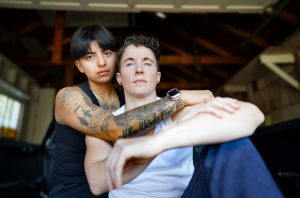
Chosen names are what people use to articulate a part of their identity that may not be reflected in their birth name. In the Queer community, this can happen when transgender people – like myself – experience a friction between the way that they’re referred to and the way that they feel.
Choosing a name for yourself can be an instrumental step in affirming your gender identity.
Image by: Leyre
To me, chosen names offer a synthesis of literary and psychoanalytic analysis.
When you choose a name, that name is imbued with references, history and storytelling. Naming takes abstract ideas and applies them to a person.
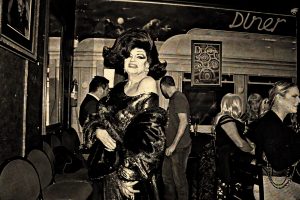
For example, the drag name Divine was a gift to performer Harris Glenn Milstead from legendary filmmaker John Waters. Divine is famous for her performance of filth; cannibalism, murder and bodily fluids abound in her art. Through her filth, she is transcendent. She is Divine.
Take perfomer Elizabeth Rosemond Taylor’s nickname and stage name, “Liz Taylor”. The strong ‘Z’, like a puncture or a hiss, reflects the character of the person attached to it – in this case, a shrewd bombshell, vicious and witty.
Take 1940s pin-up model and actress Julia Jean Turner’s chosen stage name, “Lana Turner” – its open vowels, the ‘T’ a light touch to the roof of the mouth. The softness of the name can be read as a bid to align herself with the ideals of what white American femininity endeavoured to romanticise: classiness, elegance and vulnerability. The legend goes that Lana Turner was proposed to when her boyfriend dropped a diamond ring into her martini.
It is no coincidence that musician Elizabeth Woolridge Grant, with her unconcealed fetish for white old Hollywood glamour, chose the stage name “Lana Del Rey”.
My birth name, Sophia Zikic, reflects a complex history of immigration, language and storytelling.
On my 13th or 14th birthday, my aunt on my father’s side incorrectly wrote my name as “Sofija” on a birthday card, despite knowing me my whole life. It was a surprising – but illuminating – mistake.
“Sofija” is the anglicised spelling of Софија, a name found in South Slavic and East Baltic language groups. “Sophia” is popular across most Eastern Orthodox cultures, from the Greek Σοφία, which came from the ancient Greek σοφία – the soph borrowed from philosophy, meaning wisdom or skill. “Sofija” would be the spelling of a daughter born in Belgrade, where my dad and my aunt are from.
But instead, I was named for an English-speaking culture – one in which my mum and dad were both immersed. It was more important to them that I be named for the culture I belonged to, rather than the one either of them technically came from.
A Western name is intended to ease the passage of the children of immigrants. When those immigrants are not white, a child’s Western name may additionally become a safeguard against racial discrimination and violence.
Queer communities have always had their own language and references.
When I was choosing my name, I wanted it to be situated within Queer culture. It seems that other people feel similarly.
Take non-binary and trans people who choose to name themselves after things instead of ‘traditional’ names – such as my friend Forest. This naming convention seems to reflect a desire to resist the gendering that most names impart, instead drawing from the affect of the non-human, even the non-sentient.
Forest is a person, but forest is also a space filled with myth, history, life and potential.
I don’t have a name like this, but I deal with the gendering of my birth name by including the slash. The slash invokes multiplicity – an experience of transition that I struggle to make others recognise.
Unlike my birth name, Dorian belongs to strong Queer lineages.
Dorian Gray, Oscar Wilde’s titular protagonist; Dorian Corey, founder of the House of Corey; and Dorian Electra, an American electronica musician, are all figures of Queer history and culture.
Additionally, as a gamer and fantasy lover, I also named myself after a Dorian character from a favourite role-playing game (Dragon Age: Inquisition fans, rise up!).
Dorian, like Sophia, is a name that grows in symbolic significance if you are familiar with its lineages. But I chose it to communicate something about me – my knowledge, my passion, my sense of self as a Queer person – to those around me who are in the know (that is, other Queer people).
There is a shadow to chosen names – which is the ‘deadname’. A deadname is a birth name that does not reflect one’s identity. They are usually associated with the gender we were coercively assigned at birth.
While chosen names are a way of articulating trans power and agency, being ‘deadnamed’ – regardless of whether it is purposeful or accidental – is a way that people undermine that power.
Truthfully, I can’t call “Sophia” a deadname, because at least for now, I can’t allow myself to be wounded each time I hear it.
Instead, “Dorian/Sophia” offers a window into my experience of gender beyond interpretations of my appearance. It expresses my trans identity, which has always been politicised, and has recently become the focus of nightmarish public policy.
This name suddenly feels precious, something that can only be entrusted to people in the know.
A chosen name offers something truthful and vulnerable, regardless of whether it is a drag name, a stage name, or a name for day-to-day use.
When we are perceived as at odds with our name, we are opened to the potential for violence. It is why some people work hard to ‘pass’, so that our names may match how we’re perceived, and we are shielded once again. I am aware, unfortunately, that this invisibility is the desired effect of transphobic policy – to force us out of the public eye, and to feel like we must protect ourselves at all costs. But then, that is one purpose of a chosen name: to reclaim some of that power.
If I am perceived as my gender assigned at birth, but my name is Dorian, the world may have a harder time denying who or what I am.
Recently, I went out with a group of close friends – all transgender, some non-binary, some trans-masculine, some trans-feminine.
We yelled at each other over the music. I was wearing silver eyeshadow and lipstick.
With those friends, who really knew me – the lineages, the resistance, the language and the history – I was just Dorian.