

Adoption, chosen family and queer belonging: Fire makes family
By: Shele Parker Black
Advertisement
Content note: This piece discusses family trauma and briefly mentions the HIV/AIDS crisis.
Whenever people learn that I’m adopted, they often ask a simple question that has always felt impossible for me to answer: What’s it like?
Historically, I’ve managed polite – albeit squeamish – responses that begin with precursory minimisations and end with sad jokes that only amplify my discomfort.
“Families, right? Can’t live with ’em, can live without ’em. Haha!”
What I know now is that being adopted is to be always looking out for a smoke signal on a hill – the sign of a campfire, perhaps a little comfort.
All images: Courtesy of the author
For me, the experience of being adopted is to survive an attack on the soul. Strong words, I know.
Of course, adoption does not have to be a catalyst for grief. As a mother and daughter in my own broadly queer family, I wholeheartedly support surrogacy and adoption as tools by which people create families. For me, the critical concern is with management. By that, I mean the choices that families make.
I lost my entire biological family and history at birth, but it didn’t have to be that way. My adoptive parents could have made better decisions for me and with me.
Instead, they chose to erect multiple obstacles and barriers that prohibited me from finding my biological family, including withholding my adoption documents. I have trauma borne from these choices.
My adoptive parents were capable of making good choices; they were excellent practical providers.
However, they did not manage their own insecurities and fears, which exacerbated my grief. Their fear of what calamity might come should I decide to reunite with my biological family was a pervasive and alienating force throughout my childhood.
Their emotional distance and overwhelming sternness towards me marred our relationship so much that it became the driver in my decision to search for my biological parents.
At 15 years old, I left my childhood home to find people with whom I could connect and feel comfortable – and perhaps feel a sense of belonging to.
It felt like a fruitless exercise: casting myself out into the world, in search of something I’d never felt before.
That is until I stumbled across something that took hold. Something that connected the wires and set off a spark. It lit a warm fire in my belly.
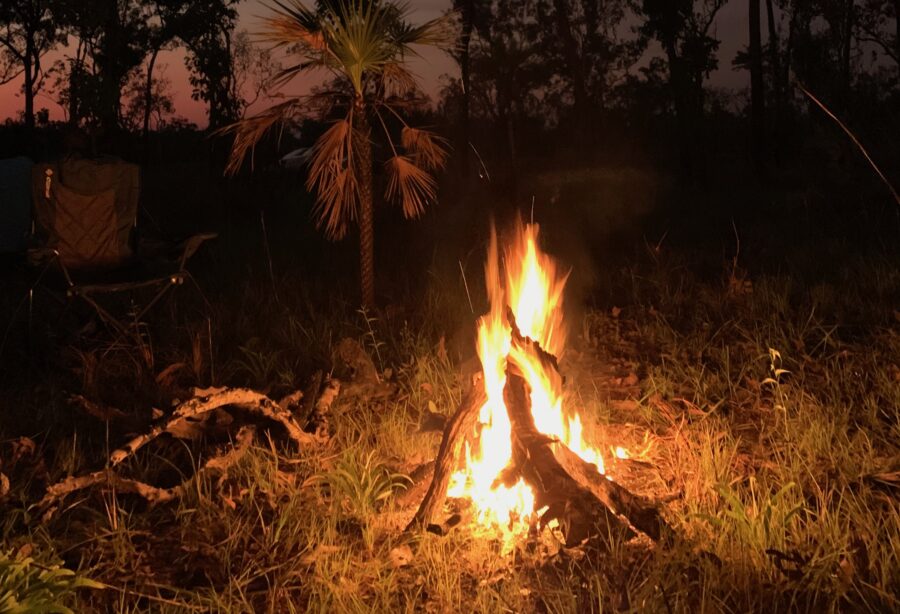
A campfire somewhere along the Stuart Highway, NT. Photo supplied by author.
I was 16 when I found a house I’d keep returning to. I’d found other runaways there: fleeing foster kids, kids who would have been sleeping rough otherwise, some kids who had left ‘good homes’ like me.
Kathleen, who already had six of her own children, let us come and go as we pleased. We used the slatted understorey of her housing commission flat as a base. Here, we tried to create better lives for ourselves.
The people at Kathleen’s place were the first people to make sense to me. Our time together was a geyser of spontaneity and playful ruthlessness. Mischief and misadventure. Laughter and love on loop.
When Kathleen’s own kids grew up and started to leave home, we did too. Spirit buoyed, my search became easier. I knew what it felt like for a spark of comfort to ignite. But before long, that little fire I’d managed to light went out – and it stayed out for some time.
A few years ago, I took a road trip down the Stuart Highway with my friend, Pat.
I’d been despondent; it had been so long since I’d felt the spark of belonging. My despair was palpable, and Pat, perhaps in an effort to save our road trip from morbid ruin, tried to help me light it again.
We’d woken up weary in our swags after a night eating lamb chops and watching footy at the Renner Springs Desert Inn.
We were stretching our legs along the lonely expanse of highway, when Pat pressed me on my sadness.
I tried to articulate a particular grief that I reserved specifically for the adopted. I spoke to him of my isolation. I told him I was desperate to find my community. Pat met my gaze with exasperation.
“I’m right here. We’re right here,” he said. I sucked my teeth. I didn’t understand; after all, Pat wasn’t adopted.
Pat is a gay man who came out to his parents only to learn a cruel truth: he was born to insipid homophobes. The unthinking kind who thought the AIDS crisis was the cause of ‘the homosexuals’. His father voted No in the plebiscite on marriage equality.
I figured that Pat would tell me that knowing one’s biological family isn’t all it’s cracked up to be, but that wasn’t his point.
Instead, he explained to me that the LGBTQIA+ community, of which I have long been a part, can empathise with a significant part of my suffering.
The reason for Pat’s exasperation became clear to me: I was not the only one who’d had familial fabric ravaged by my own parents.
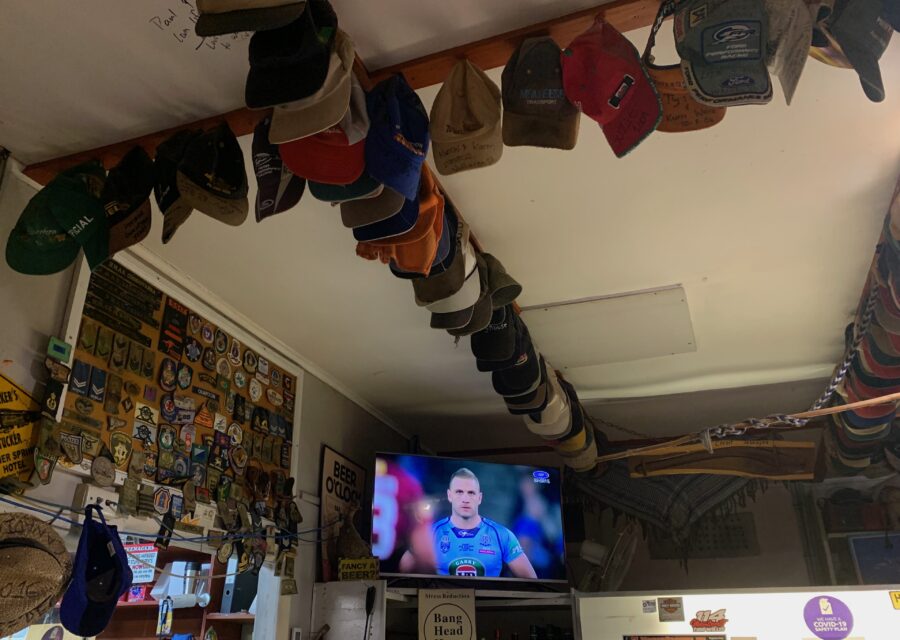
Footy at the Renner Springs Desert Inn, Renner Springs, NT. Photo supplied by author.
Adopted people and LGBTQIA+ folks can share experiences of shame, rejection, guilt and resentment. Sibling rifts and divided loyalties can be shared too.
In my mind, all of this returns to management. So many of these experiences could have been remedied by caregivers making better choices for themselves and their children.
Better choices might look like reflecting on discomfort, engaging in professional help to explore difficult feelings, or inviting those affected to engage in facilitated dialogue about said difficulties. It would look like respect, care and commitment to love – for oneself and their children.
For Pat and I, and others like us who are cast out into the world alone, trying to make sense of it all – what is left for us to do but find our Chosen Family?
The next day, while Pat coaxed the previous night’s coals to catch, to make a little cooking fire for our breakfast, I grasped the enormity of what he had given me.
Pat had given me language. With this fire of comfort we have – to warm ourselves by, to share our stories around – we can cauterise each other against the pain caused by our families’ choices.
My Chosen Family, strewn across every stretch of this landmass, have built the very foundation from which I have been able to flourish.
They have buoyed me, bolstered me enough so I can face the challenges set upon my path by others. I return this strength in reciprocity, because what my Chosen Family have taught me is that our losses and wins are shared.
As this essay (and love letter) is, in part, about legacy, I would be remiss not to mention some people whose love I poured into the creation of my daughter.
To S, who struck lightning right through the heart of the fear I had about motherhood: “your daughter won’t have the mother that you had.” To J, who cradled me through a pregnancy defined by hellraising grief, displacement and isolation while carrying hurt of their own. To my daughter’s brother’s mamas, K and B: by raising our children together, they saw the sorry, empty cup of my own early childhood and filled it to the point of overflow. May [our] cup[s] runneth over.
There is one thought that will forever radiate warmth and light in my darker hours: my Chosen Family were strangers to me once. Who else might be out there?