

Transness, body image and travel: I ate cheese on holidays
By: Erin Riley

Advertisement
Advertisement

Advertisement
Content warning: This article discusses disordered eating and disordered exercising.
For a long time, I was not a fan of the overseas holiday. I was rigid and liked routine, and had struggled on my few previous international trips. I had trouble navigating new places and found change and spontaneity difficult. I had flown to Europe once before, in 2013, and, knowing myself well, visited just Berlin and Copenhagen – two cities, all I could manage.
A lot has shifted in 10 years. The big change was a willingness to lean into risk and push past anxiety in order to experience the world more fully. I’ve found that with flexibility comes rewards worth noticing. It’s how I, once too afraid of the ocean to swim in it, became a surf lifesaver earlier this year.
Now, almost 10 years after my two-city Euro trip, a time when I replicated my Sydney night-time routine by streaming episodes of the Danish series The Killing on my iPhone in a Berlin bunk bed, I find myself shirking my old travel narrative.
My partner, Merryn, is thrilled when I commit to five full weeks criss-crossing Europe to coincide with our one-year wedding anniversary.
All images by: Anna Hay
This article appears in Archer Magazine #19: the PLEASURE issue – buy a copy here.
We visit family in the UK and Sweden before a week in Croatia where we swim endless kilometres of crystalline blue Dalmatian coastline each day.
Before this trip, my veganism flexibly incorporated eggs. We’d spoken before our holiday about whether I might eat cheese, especially in France, where we would end our European holiday, to experience its cuisine more fully. I was unsure.
In Sweden, we visit my partner’s uncle, Bruce. We take a ferry to Visingsö, a small island that sits in the country’s second largest lake, Lake Vättern. We see stony fragments of Sweden’s first royal castle and ride bikes through fields and forest. We stop to swim in the lake, which, despite it being the height of summer, remains a glacial 10 degrees.
At lunchtime, we emerge at a café in a clearing. It is unstaffed and the sign encourages us to help ourselves. There’s an honour system and we pay our money and take three sandwiches, a soda water and one cake each. We sit under the wide shady branches of a tree.
I unfurl the roll from its plastic wrap. It is cold and fresh; the size of a hand. After all the biking, I’m hungry. Inside, crisp iceberg lettuce is liberally layered with slices of cheese lazing on top. I’m deliriously happy about the simplicity.
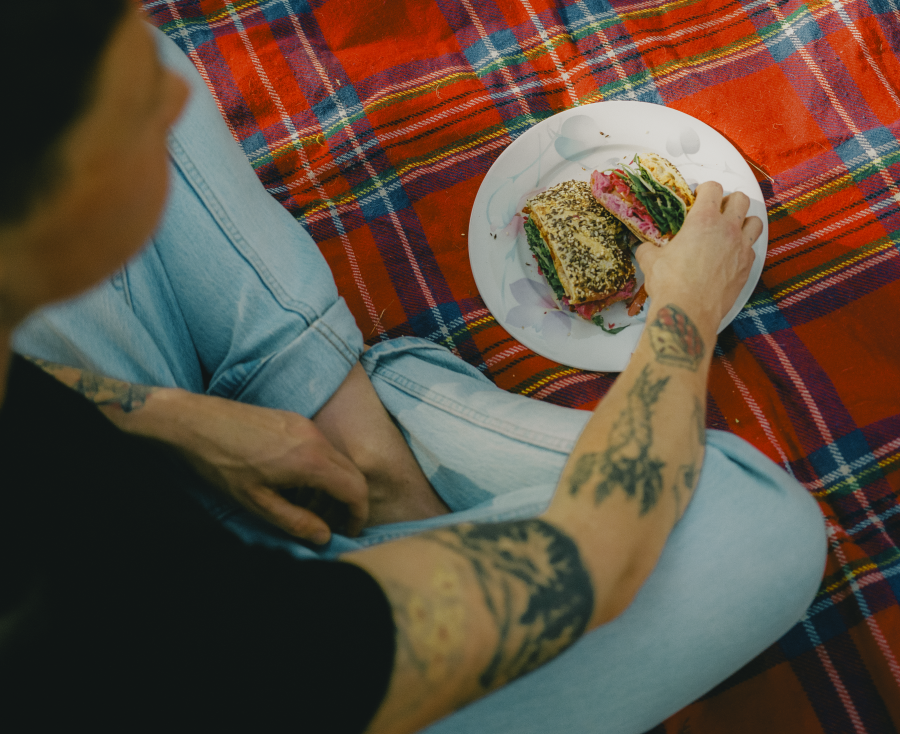
Image by: Anna Hay.
Control, over many things, but particularly food and exercise, has played a supporting role in my life for a long time.
On holiday, somewhat unexpectedly, I was allowing myself more flexibility with food in a way that was no longer emotionally painful and was providing such pleasure. There is a thread that sometimes weaves together transness, problematic eating and disordered exercise. Research indicates that trans people are significantly more likely to experience an eating disorder than cisgender people.
Exercise, for me, was one of the ways I was trying to manage my dysphoria. Exercise was a daily affirmation of sorts. It was liberating that the quite simple thought – I am trans – materialised from a lot of introspection. Exercise was the stand-in for the medical affirmation I yearned for, but, at the time, wouldn’t allow myself to think about.
I had a similar relationship with food, but, in a way, less obvious.
On our European holiday, I eat things outside of my usual routine but without shame or distress. I experience a profound lack of guilt around eating cheese.
I am nearly 40 and, for 15 years, I was vegan. Maybe it was my own internalised shame around more flexible eating, honed by years of dogmatic vegan discipline, that meant I took a long time to think about how my relationship with food and eating was entangled with my gender.
On our guided swim tour, I wear a pair of blue Speedo bottoms adorned with red and yellow lifesaver flags. It’s the first pair I bought for myself to wear with my naked chest. We swim five kilometres each day – half in the morning, the other half in the afternoon.
I oscillate between the lifesaver togs and a pink one-piece festooned with sulphur-crested cockatoos. My swimming companions find my swinging between the two to be a curious choice. Someone asks why I wear the one piece. I reply, simply, “I really like it.”
Wendy from Brixton looks at my chest and asks, with shocked curiosity, “What happened to you?!” Later, it means nothing because we are the best of friends and I am their example of life in the middle.
Long into my twenties, I covered my body from top to toe, even in summer. I layered long-sleeved T-shirts underneath regular ones. I believed myself to be a lifelong never-nude. I am near naked in the Adriatic Sea on holiday and I feel at ease.
My relationship with food and eating has changed as I have affirmed that I am trans. There is more permission for nourishment – at its most basic level as it relates to actual nutrition, but also as it relates to the pleasure of opportunity and experience. To take up space, in my actual body and in the world.
Lunch is prepared each day as we frolic in the water. We climb back onto the boat, take a plastic plate and help ourselves from containers full of pasta, roast vegetables, salads and battered local fish. There are sliced fresh tomatoes and fruit bought before dawn.
We grab chunks of bread, balance plates on laps and chatter away with our mouths full. There is locally-made sheep’s milk sir (cheese), believed to be the world’s oldest cheese, dating back 7,200 years to the very Dalmatian coastline we are swimming.
I place the triangled slices onto the bread. It’s chewy with a tangy bite. It is delicious and I love it.
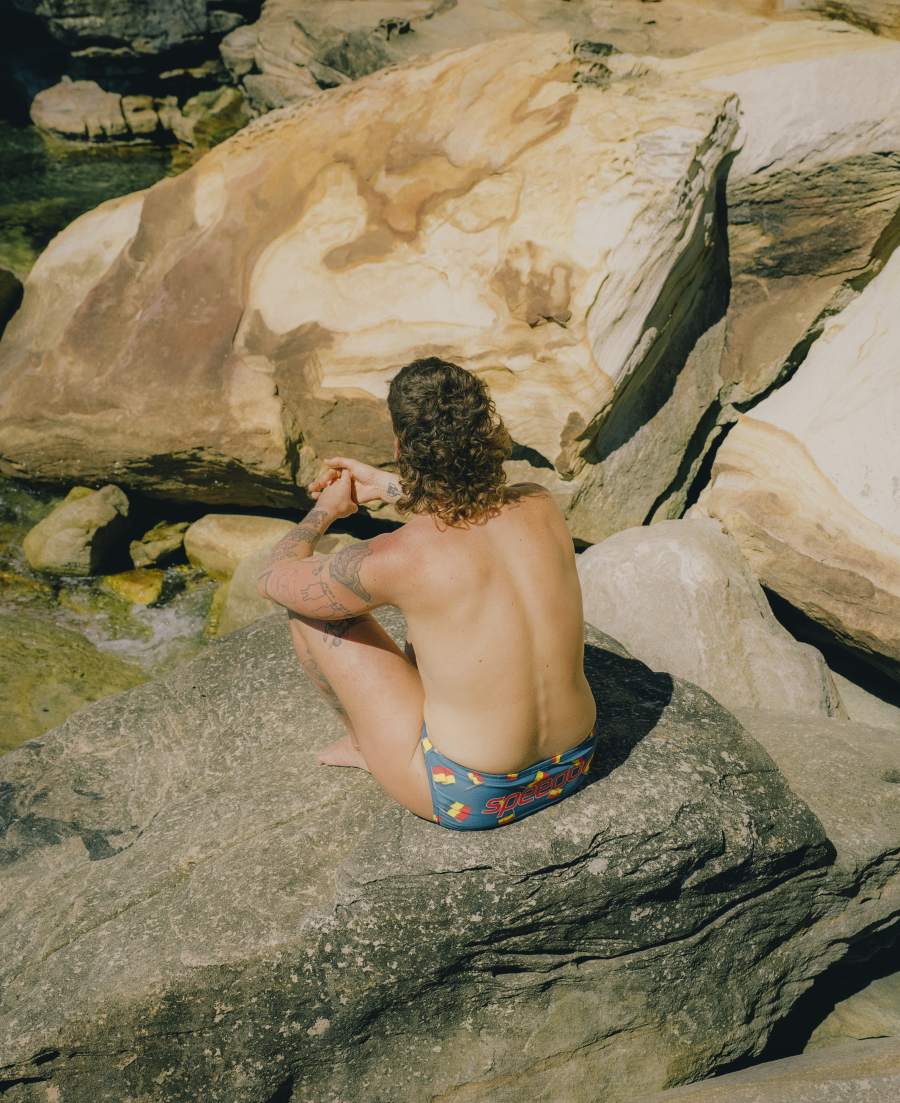
Image by: Anna Hay.
Back in Sweden, our distant family had invited us to dinner. While this stretch of kindness bordered on awkwardness, we accepted.
Magnus, a wiry, tanned man in socks and Birkenstocks, hugged us at the door; his head, bald and shiny, glasses framing curious eyes. His wife, Berit, grey hair in a loose bun, face full of kindness, ushered us inside and poured us apple cider squeezed from local apples; cold and thick and sweet.
Magnus barbecued vegetables on an enormous wok in the sun. We sat at the window overlooking Lake Vättern and scooped vegetables that tasted like gold. Along with asparagus, carrots, onion, peppers, garlic and potatoes, were cubes of toasted haloumi – a salty, pillowy decadence I had long forgotten.
After dinner, we toured their garden, full of rhubarb and roses. The yard snaked skywards behind the house and at the top perched a greenhouse high above the lake. Inside sat five chairs. A bowl of strawberries and melon rested on a table. Next to it, a carton of cream. Five small bowls. The strawberries a first kiss, unparalleled. I poured the cream generously, took in the sparkling view.
People know me to be a lover of food.
Historically, I am the one to go hard at a picnic, to go back for more. To think about the next meal before finishing my last. My friends, good for them, refuse to share a meal with me, knowing they’d not receive their fair share. I do not miss out on food, or restrict my intake, because I love to eat.
Veganism aligned with my values, but the clear boundaries of veganism found synchronicity with the control I found in exercise. As I am not a woman, I believed I was unfazed by the norms and beauty standards assailing women, so I didn’t understand my behaviour of restriction – of trying six months of keto as a vegan, of trying intermittent fasting – as disordered.
My complicated relationship with food was certainly about body image – trans body image. A trans-masculine body image awash in myths of masculinity and anti-fatness. I was controlling what I ate because I was trying to be read as the androgynous person I knew myself to be.
Control over food gave me aspects of this gender presentation in ways I was not overtly aware of but, as I’ve affirmed my gender, became clearer.
I eat more cheese in Villefranche-sur-Mer, on the French Riviera, on a tiny balcony in the old town, overlooking a sea of cobalt blue.
Ancient bells toll their daily tune, and birds circle the endless summer days. We buy French cheese at the small corner store, wrapped in red striped paper. We buy two baguettes. We make cheese plates every day in Villefranche-sur-Mer, sit on the balcony overlooking the bay, and develop an appreciation for the aperitif, sipping the limoncello we find in a cupboard.
In Marseilles, we eat the finest French food yet – delicate, crafted with precision and care – and I keep tasting cheese. The next day, we roll our bags the 10 minutes to Saint-Charles Station.
At a chain café called Paul, Merryn orders deux baguettes. Mine bursts with tomatoes, soft mozzarella, pesto and olive oil. Paul’s generous – there’s plenty of cheese
inside, and I feel fine parting with €6 for its company. I order un café allongé. The staff make it by pressing a button on a machine that requires no barista.
The sandwich is crisp and salty and I chew slowly, with fine attention. I am a child trying something for the first time. Merryn’s sesame baguette is swollen with creamy camembert popping out its edges. We hand over our baguettes for a try and return them, cheeks full.
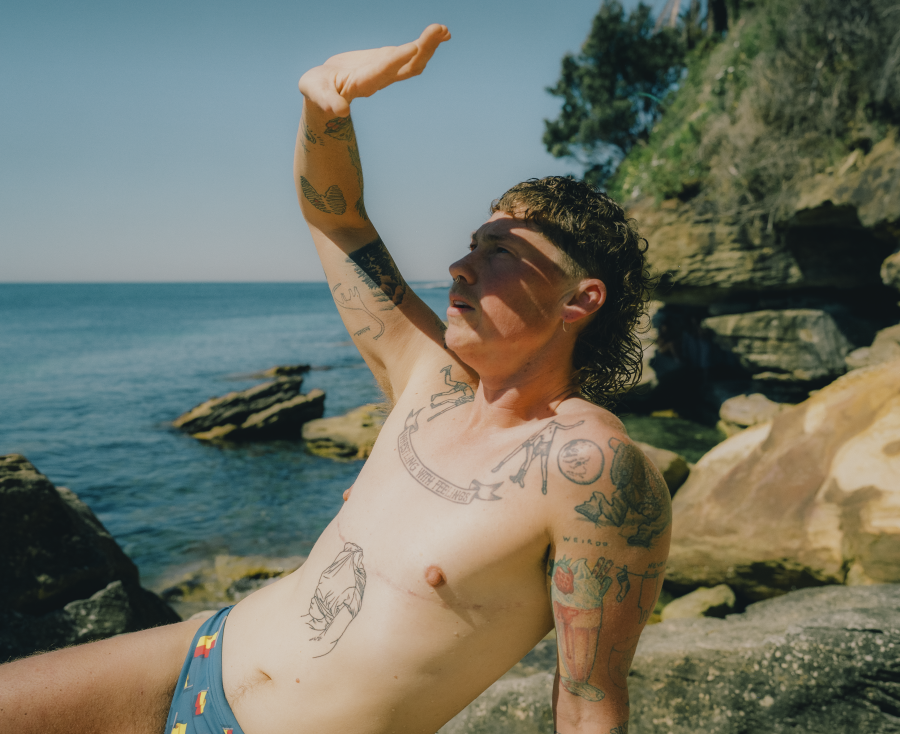
Image by: Anna Hay.
In Paris, we stay in Canal Saint-Martin.
There is a fromagerie five doors down. Inside are smells foreign and inviting. Like a gallery, everything is in its place. It’s quiet and minimal, yet there’s much to see: cheeses mounted on platforms, displayed on shelves high and low, encased in glass and in sections of fridge open to the touch. Cheeses of all colours and textures, some with mould that looks crafted by thousands of tiny worms.
A man asks us what we are after. He slides out a cutting board, and, like a jeweller, places the cheese down like a precious stone. Slices us some. It’s tough and stinky with a turmeric-coloured shine and I taste a thousand sensations. He wraps a triangle in thick, off-white butcher’s paper, and we buy eggs and a baguette at the boulangerie and go home to eat it all.
Merryn notices that the food in Paris is on display; unapologetic. Hot ass on the French Riviera. Windows full of cakes and colourful, refined French pastries.
In France, food seems freer somehow – its value inherent because it is tasty and an experience in itself. People eat outside on the street, late into bright nights.
Back home, there’s a moralising around food and eating. Treats are hidden away, cakes wrapped in plastic that shouts abrasively about how healthy they are, as if trying to prove themselves worthy of consumption. These same insecurities are mirrored in the paranoid language around so many meal tables; the need to earn a treat, the ‘better nots’, the shame of wanting more. Food is deemed valuable for what it does not have: sugar, calories, fat.
We fly home via Doha, Qatar, where queer people face discrimination, harassment. It’s strange to think about this inside the bubble of the terminal, where we have 14 hours in an airport hotel.
We sleep in a king-sized bed and, after, I ride the lift to the gym. I am gendered as a man.
“Sir, the gym is to the right, the men’s to the left – they are separate”, a male hotel employee says, motioning to the gendered changing rooms.
Later, Merryn and I swim in the pool atop the boarding gates. Orange afternoon light floods through the glass roof and tiny blue tiles sparkle though the water.
After we swim laps, we separate. Being gendered differently offers a pleasure; it does not bring with it a shackles-up anger that I have been misunderstood again. The changing room is a curvy palace, where pristine white walls reach high ceilings. In a dimly lit corner, illuminated by light that pulses from blue to red to green, is a spa. Speakers play meditative drops of piano. It’s beautiful here in the darkness and I plunge my body into its warmth.
In the dimly lit quiet in Doha, I recall the younger me, nervous in Berlin, desperately clinging to the familiar, the small. How so much has shifted, in relation to not only my body, and to food, but to travel, too. Back then, sitting in a spa in an airport hotel, almost naked, trying new things, would have seemed impossible.
I look down at my tummy, its fuzzy snail trail, the body reflected under the water in the lifesaver Speedos. Nourishing it, finally.
This article first appeared in Archer Magazine #19: the PLEASURE issue.