

Non-monogamy, family and nurturing Country: Poly lessons from the murnong
By: J Rogers
The arithmetic of us is not complicated, though people always want it to be.
I am the poly one. Adi is my husband; Bella is my girlfriend. Adi is bisexual, and he and I sometimes share other men. Bella is bisexual, too. I am her only partner, though she is open to men if one ever comes along worth the trouble. Bella and I don’t date other women.
Adi likes Bella. Bella likes Adi. Nobody is cheating. Nobody is hiding. Nobody is in distress, except occasionally my youngest child when we run out of Bella’s sourdough – he is addicted to it, and always demands more Bella Bread (yes, she’s that sourdough queen!).
There is a husband, a wife, a girlfriend and three children. On any given week we are three adults who work too hard and have three kids at school or playing up for mum. By the time the weekend comes, we just want to veg. Is it sexy? Probably not. But it is a life full of love.
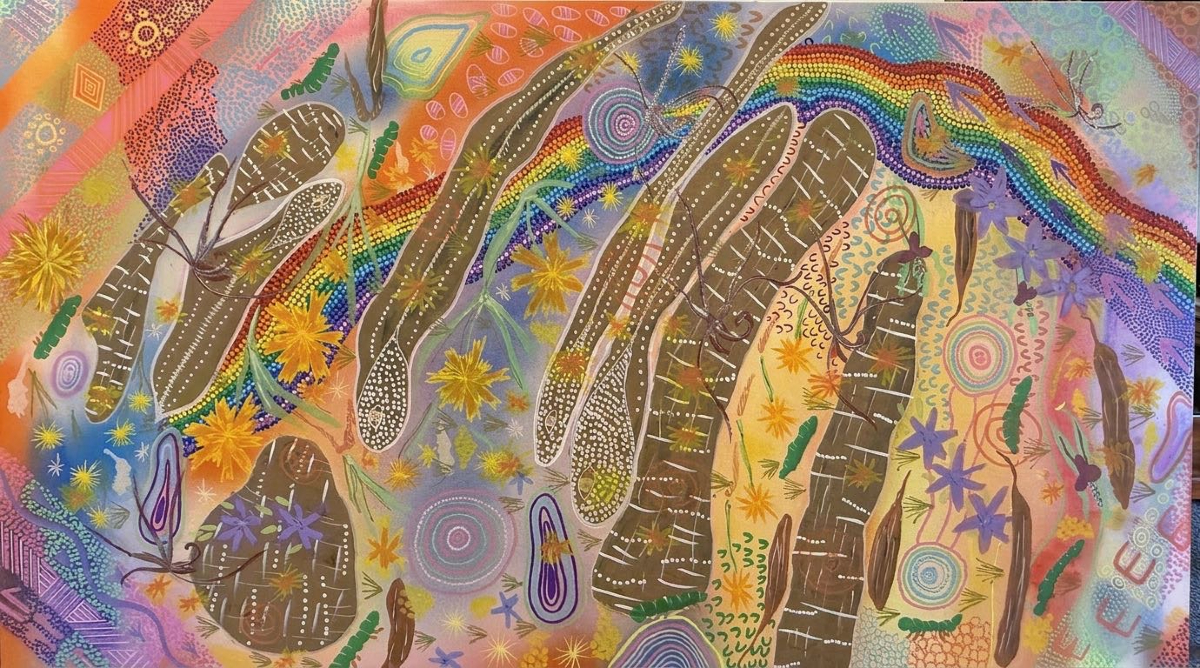
Image: Artwork created by the author
As a Wiradjuri woman, everything comes from and returns to Country.
The murnong, or yam daisy, is a small yellow flower many mistake for a dandelion. Underground, a sweet white tuber grows for eating. Murnong used to carpet the plains of this continent so thickly that early colonists described the country as looking farmed – because it was. It was tended. By women. By my own women.
Last year, me and my son – who had never grown murnongs – planted three seedlings in our rose garden and one in a pot by itself. They grew very small. This year, Bella and I are going to plant as many of our hundred seeds as we can in her garden five minutes from ours, and my son will come with me to tend them as they grow.
I live with Adi and our three children in a house that is always slightly too small for us, even though it is the biggest I have ever had. My youngest is six. On the mornings Bella has stayed over, he climbs into the bed where she is sleeping and burrows under the arm that isn’t pinned. Bella, not used to small hot bodies launching themselves into her sleep, makes the soft grumble noise of someone being loved by a person who has no interest in asking permission first. It warms my heart to hear him say, “I love you, Bella, you’re my best girl.”
How lucky I am to have so much love in my life.
This is our family. I am writing about it because I am tired of never seeing families that look like mine. When people see us, they continue not knowing what they are looking at. It hurts when people pass judgement on choices that are supportive, relational, respectful and life-giving.
Sometimes I feel like that lone murnong we put in a pot. Murnong don’t do well on their own. I am writing to remind myself that we are part of a huge queer and poly community. That we are not alone.
Bella and I are both femmes. In almost every public context, we are read as friends, sisters, colleagues, or a mother and a slightly younger mother: anything but what we are. At our favourite coffee shop, where we have gone together every week for a year, where the barista knows both our orders, we are still sometimes asked if we are waiting for someone else, or treated as business associates.
At events where I invite both Bella and Adi – because they are both my partners, and equal parts of my life – I watch people’s eyes skip over her and land on him. I watch Bella notice their eyes land. I watch her decide, again, not to make it a thing. I see Adi doing the same. It shouldn’t be this way, but it is the society we live in.
Liz Duck-Chong wrote an essay in this magazine a few years ago about being met with a sideways smile at the mention of non-monogamy: the one that says, We get it, you fuck, as if the most interesting thing about our lives is who is in whose bed. I read it on the tram the week it came out and laughed so loudly the man next to me got up and moved.
What I want to say, and what I am still figuring out how to say, is that for mob, this smile lands differently.
It is not just that the person in front of me has assumed my relationship is about sex. It is that they have assumed my family is a Western one: a mum, a dad, a nuclear unit, a bloodline that goes up and down like a ladder – and that when I tell them it is not, they think I am the one deviating.
As if monogamy was the default here. As if the nuclear family has ever worked as well as our Indigenous structures of relatedness, which have always held queerness, multiplicity, shared marriage and shared sexuality practices inside them.
Murnong do not grow well on their own.
Here is what they do instead. After the first autumn rains, a dormant tuber underground sends up a rosette of long-toothed leaves, narrow and dark green: the plant announcing itself. Through the cold months, it gathers. Come spring, a hollow stem rises, and at its top a single bud emerges – pendulous, hooked downward as if the plant has not yet decided whether to risk the world. Then the stem straightens. The bud lifts. A yellow flower opens and faces the sun.
By summer, the flowers are fluffy seed heads, the leaves die back. Looking from above, the plant appears to be gone. But it is not. Below the surface, the tuber has been quietly multiplying, branching, sweetening, making new tubers beside the old one, a whole hidden system that next year’s rosette will rise from.
You cannot see any of this from above. You have to trust it. The way Adi trusts me – his wife of 12 years – to be in another committed relationship. He has no direct line of sight into the feelings Bella and I share, the particular shape of us. He knows it is life-affirming, and that is enough for him.
Plant a single tuber in a pot and tend it perfectly, and you will get one small yellow flower and one small white root, and in a year, maybe, a second tuber. Plant a bed of them close enough that their leaves touch, and they will multiply the way they were made to. They share something through the soil – mycorrhiza, a type of symbiosis – and in three years a handful becomes a hundred. They tend each other. They are a plant that does not know how to do monoculture.
I did not plan this metaphor for my relationships. It planted itself in my mind as I learned more about the murnong.
Bella’s garden has been prepared to plant our murnong seeds. She cleared a bed for us: for the plants, for me, for my son, for whatever this is that we are building. She sent me a photo of it and I cried. Because tending is love with purpose. Because preparing the ground is what makes a partnership solid. Because having something to do together, something that will feed us, feels deeply connected to who we are.
This autumn, Bella and I are going to sow the seedlings with my son. Three gardeners. Two houses. One flowering yam. I am hoping for a yam soup so we can all enjoy the harvest with Adi at our house.
There is a mourning in this, too, and hard parts of the journey I want to name. There is the ongoing work – the work of explaining (to people who did not really deserve to ask) that Bella being in my life does not mean Adi is anything less in it. That love has not been divided into smaller portions.
Anyone who has had children knows the heart can double in an instant, and you realise: love is infinite.
Then there is the particular tiredness of being a Blak queer woman explaining queerness to white people, and Blakness to queer people, and polyamory to both, over and over, at dinner parties I mostly did not want to go to.
Bella carries some of that now, and so does Adi. That is a weight I still carry, too, knowing I brought them into the less fun, more ‘explanatory’ requirements of our relationship. But Bella also carries my six-year-old when he needs carrying, and I find myself watching with the thought: this is the real version of our non-monogamy. This is the real family. This is the real Country. This is what we are tending.
And then my son asks if he can have some Bella Bread, and Bella laughs, and the moment breaks, and we get on with it: loving and caring for each other as much and as often as we can.