


Archer Asks: Caviar Club on lesbian nightlife and steamy sex parties
By: Laura Castagnini
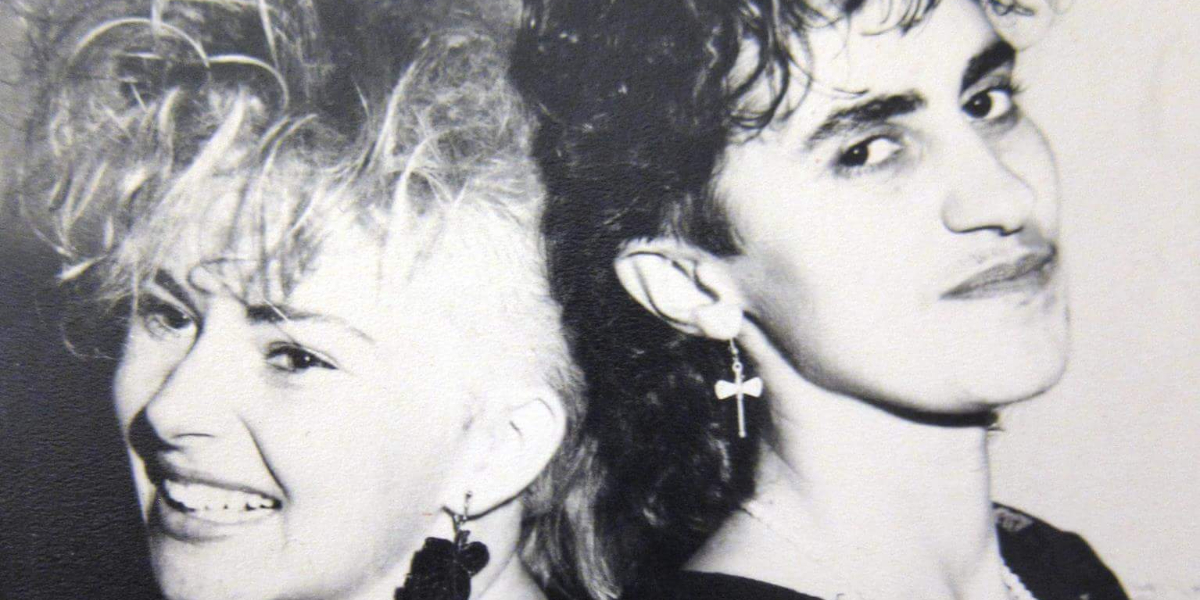
Caviar Club was known as a key fixture in Melbourne’s lesbian nightlife through the 1980s and 1990s. I wasn’t born yet when they started, but I’ve heard stories on the lesbian grapevine about their infamous dance parties, gigs and community fundraisers with a feminist agenda. Caviar Club not only offered free childcare at their events but also hosted the first women’s night at a sauna in Melbourne. In this lively conversation with four of the original members of Caviar Club, we are taken on a sprawling trip down memory lane in an attempt to pin down what actually happened at the Caviar Club.
Header image: Deborah Kelly and Letizia Mondello DJing at a women’s ball, St Kilda Town Hall, mid-1980s. Photographer unknown. Courtesy of Australian Queer Archives (AQuA).
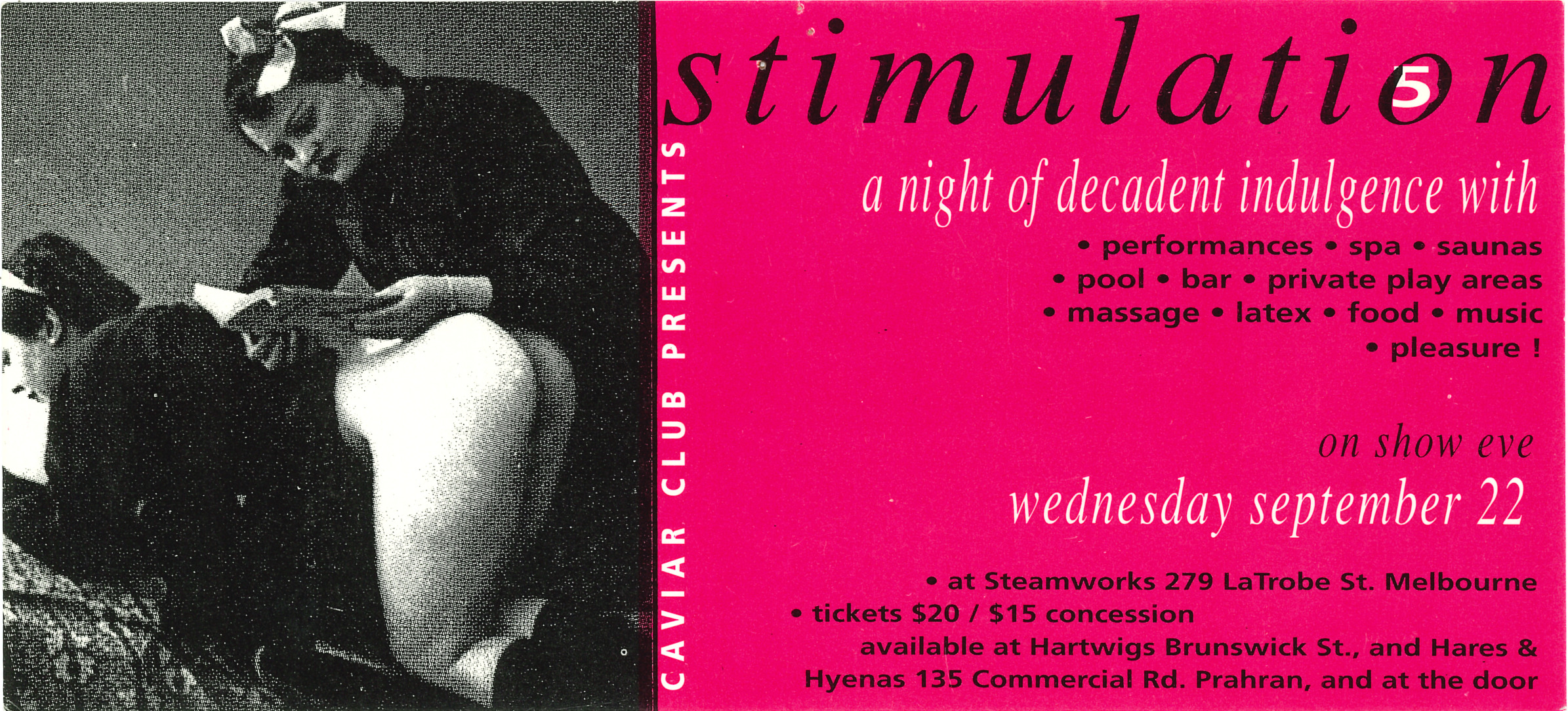
Caviar Club flyer designed by Deborah Kelly. Courtesy of Australian Queer Archives (AQuA).
Laura Castagnini: How did you all meet, and why did you start Caviar Club?
Tracey Wall: I first met Letizia at Inflation disco – their [regular] gay night on Wednesdays – in 1982. We became firm friends. And Letizia was dating Deborah. We started the Caviar Club because we were young and arrogant. We felt that we could do a better job of running a nightclub with better music for lesbians than what was on offer at the time.
Deborah Kelly: I felt like we were desperate more than arrogant because lesbian culture was so crummy. All of the lesbian nightclubs in particular played exclusively white music, and nobody dressed up. Everyone was just there to get hammered, and there were always horrible screaming, hair-pulling fights between drunk people. It was harder to be queer then, so people lived with shame and there were serious substance and alcohol abuse problems in the community. We were trying to help make a world in which we could bear to live.
Letizia Mondello: My memory was that in Melbourne at the time, there was a bit of a division between the Bar Dykes and what we used to call the University Lesbians. We wanted to attract a really big, diverse audience where everyone could go out and have a good time. Our first event was in 1984, upstairs at the Metropole Hotel. We did not tell them it was a women’s only event – we were too petrified. We got over 500 people through the door, which I think totally blew us away.
Deborah: I want to remind people from our very first event upstairs at the Metropole that we had a live band, Uncle Torquemada. They were very literary musicians, and the singer was Magda Szubanski.
Letizia: Sorry, I have to correct you, Deborah, our very first band was Barbie’s Dead. We did have Uncle Torquemada, probably the third or the fourth event.
Deborah: Really, are you sure?
Letizia: I’m sure! [all laugh]
Lauren Finestone: I was a latecomer to the Caviar Club. I came out in 1986 and I went to a handful of Caviar Club events as I was coming out. Caviar Club was definitely an important part of the queer dance scene – it was the best thing on the scene at the time. I was involved in Melbourne Uni student politics and queer stuff that was going on there, like the magazine Judy’s Punch.
There was an event run by the Gay Society at Melbourne Uni where Christos Tsiolkas was DJing. He was a good friend of mine, because we’d co-edited Farago the year before. Somehow I got up there with him, and the two of us DJed the whole night. I don’t know if you remember this, Tracey, but you came up to me at some event afterwards and you said, “So, I hear you’ve been spinning a few discs lately. Well, the Caviar Club have met, and we’ve agreed to ask you if you want to join us.” And I was like, “What? Are you kidding me?”
Letizia: We were collectively-run, which I think contributed to our longevity. The other two members at various points were Ruby Jane Stormer and Lesley Crofts.
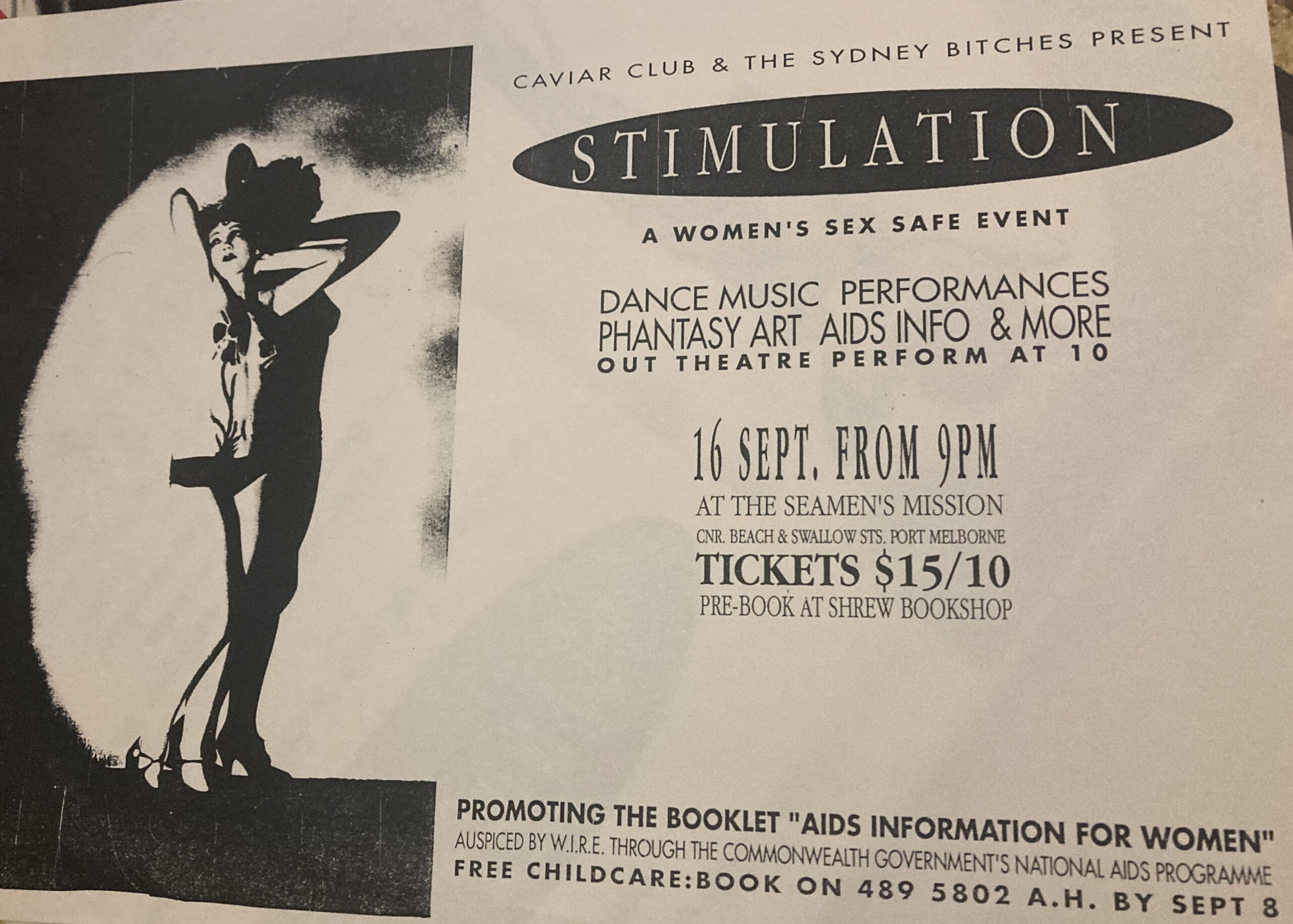
Caviar Club flyer designed by Deborah Kelly.
Laura: After a few years of organising dance parties, in 1990 Caviar Club started a series of sex-positive events called Stimulation. The first party was a safe sex (or “sex safe”) event that featured music, art and performances to promote the booklet ‘AIDS information for women’. What can you remember about it?
Tracey: We ran the first Stimulation in Port Melbourne, at the Seaman’s Mission. A classic play on words – it was the Seaman’s Mission on the corner of Swallow Street, and we ran a “sex safe” party for women.
The venue didn’t have a formal backroom or maze at the time, but it had a very strong safe sex message. That was when safe sex was first being really promoted within the community: there was lots of product and lots of lube, lots of latex, lots of gloves. It had a bit of a feeling of a Tupperware party, where everyone’s like, “Oh, what’s this?”
We had those little 5ml sachets of KY lube and lots of discussions about how they were too small for us. [laughs] I know we had performances around safe sex because we had this big tin box, like a safe, and I’m pretty sure it was Sasha or someone who jumped out of the sex safe. We also had ‘tequila girls’, who would sit on women in a chair and pour the tequila down their throat. And I did get to ride my motorbike in the crowd and do some fire-eating. I remember someone coming up after and showing me a scorch mark in their shirt. Lauren, can you remember much about it?
Lauren: I can remember you on the motorbike. I can remember the discussions around the lubes, and I can remember the tequila shots, but I can’t remember much more.
Deborah: Perhaps these things are connected. [all laugh]
Letizia: I wasn’t in Australia at the time, so I missed the whole thing. It sounds glorious. There were a few years where we only did fundraisers around safe sex and HIV/AIDS prevention, like for ACT UP.
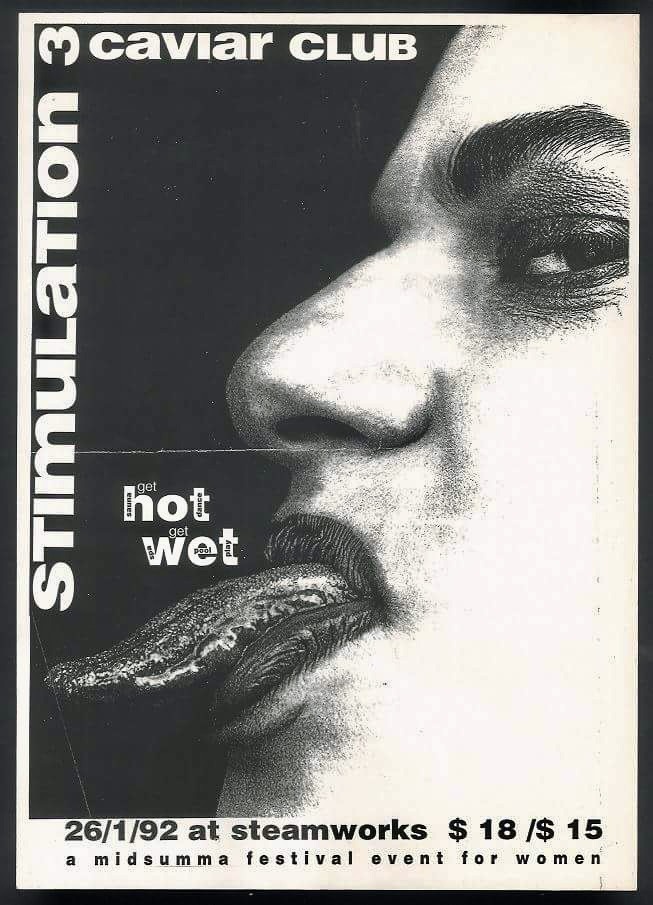
Caviar Club flyer designed by Deborah Kelly. Courtesy of Australian Queer Archives (AQuA).
Laura: The rest of the Stimulation events were held at Steamworks, a gay men’s sauna on Latrobe Street in Melbourne CBD. They were the first lesbian nights held in a sauna in Melbourne. How did you convince Steamworks to let you run events there?
Letizia: I think Ruby initially approached Steamworks.
Tracey: Yeah, I think so, too. The men’s bathhouses were suffering in decline because of the HIV/AIDS epidemic and, all of a sudden, some of them were open to approaches. We organised the Stimulation events on long weekends to coincide with really big gay and lesbian parties, when the bathhouses were quiet, so we were more likely to make them money.
Deborah: In my memory, they decided that it was irresponsible to serve alcohol at a sex-on-premises venue to men in the HIV/AIDS epidemic. They only had an alcohol licence for four nights of the year, and they sold us that licence. I really remember selling very large glasses of really good champagne for really cheap.
Letizia: We thought we were the first in Australia! We got called out in LOTL (Lesbians on the Loose), they said: “Calling it Australia’s only lesbian sex club in a press release is a bit much, when Sydney’s done it twice before. But it might be a while before Sydney does it again, and Melbourne’s doing it this month. Caviar Club is keeping up with its reputation of running innovative, stylish, and alternative entertainment for women…” I like that quote because it shows the Sydney-Melbourne competition, they’re having a go at us but they’re respecting us at the same time.
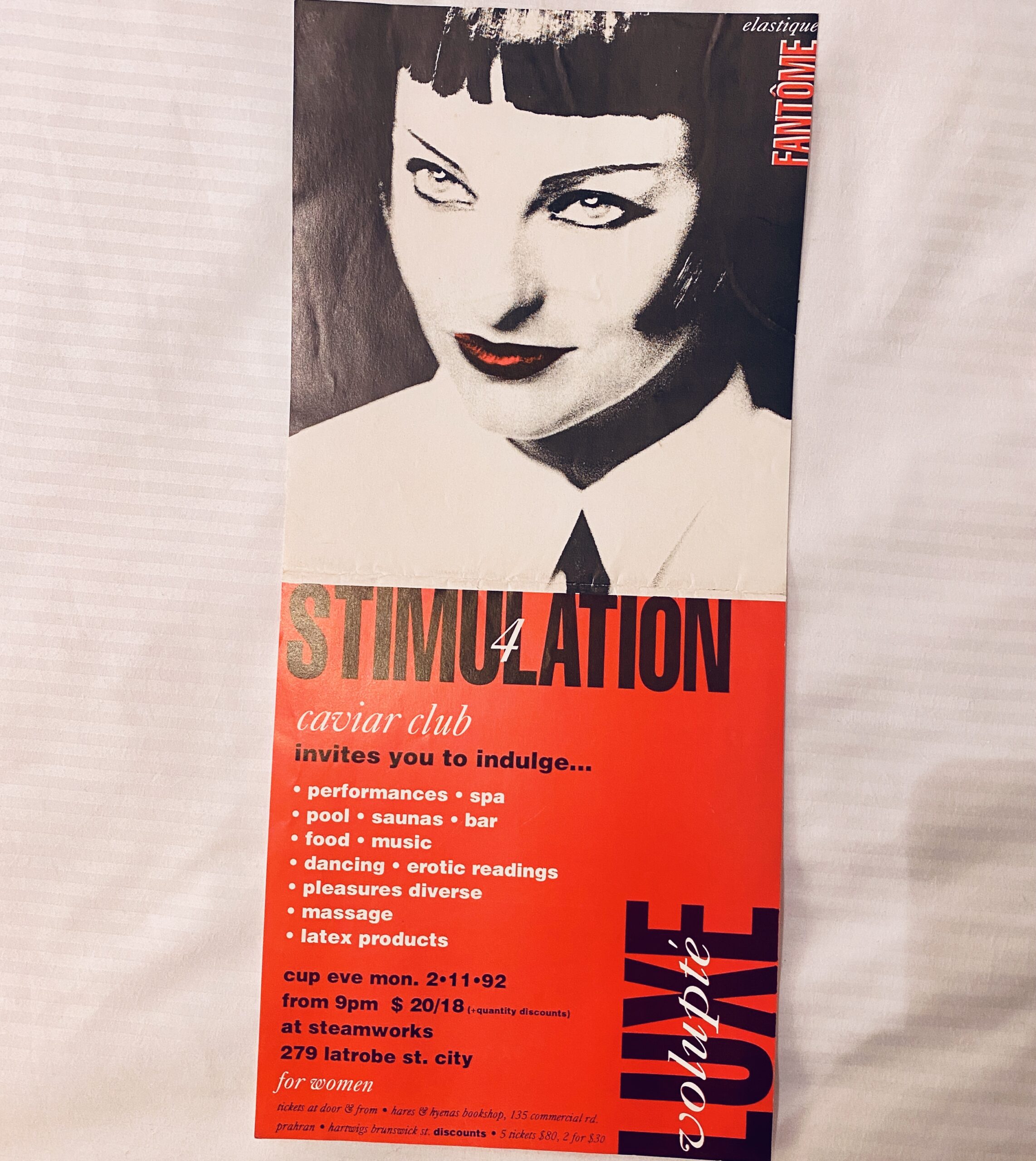
Caviar Club flyer designed by Deborah Kelly.
Laura: Stimulation was such a rare opportunity for women to explore a sex-on-premises venue. Still today, women infrequently have access to commercial infrastructure like saunas and darkrooms, which means lesbian cruising culture is still so embryonic in comparison to what gay men have been able to build. How did you create an atmosphere where women felt comfortable with the idea of cruising and anonymous sex?
Letizia: We wanted women to feel welcome, that they could have sex if they wanted to, but if they didn’t, well, that’s okay, too. When someone arrived, one of us would give them a tour, maybe there’d be three or four women in a group. We had flashlight torches because it was so dark. We would take them on a tour of the whole premises, including what was supposedly the orgy room – that usually became the marijuana smoking room.
We also organised sexy performances, and sometimes they were funny. We invited Moira Finucaine to perform, who did a lip sync to Prince, and at the end she poured a 4L jug of cream all over herself.
Deborah: You could pay extra if you wanted to have a massage. I remember organising games, like Pass the Strawberry Along. A whole room of women passing these giant strawberries around without using their hands. It was so silly and fun. It made people feel relaxed, like they were at a kid’s party, but there was, like, sex and alcohol.
Lauren: My memory was there was a beautiful indoor pool area, which was very well-frequented. And one time we had acrobats doing sexy lesbian naked tricks above the pool.
Tracey: And do you remember floating all the flowers in the pool? And then the pool cleaning system, sucking them all in, and us having to get our hands in to pull out all the lilies or whatever?
Deborah: Yes!
Tracey: We created a salon-type atmosphere upstairs, with the alcohol, the performances, the lighting, the music. People came along and then explored other elements of the venue. It was a men’s purpose-built sex venue, so it had saunas, wet areas, dry areas, mazes, open rooms, closed rooms, sling rooms.
Letizia: The venue was three stories with quite a lot of secretive corners and rooms. I don’t think I’ve ever understood the breadth of what was going on at any particular time.
Tracey: I think the all-night element of it was also conducive to experimenting. We created an atmosphere where people could take some personal risk, but in a safe space. Plus, there was a personal connection: between all of us, we knew most of the people there.
By the end of the night, it wasn’t even us that was doing the tour! Someone that had done the tour earlier was then giving the tour to the next person, who then gave the tour to the next person. And so, there was that strong sense of ownership and inclusion. I think all the women were just blown away that men had this facility. Why didn’t we have one? They can come to this seven nights a week!
Deborah: My 30th birthday was at Steamworks. I had two girlfriends at that time, and they were both there, and I had sex with both of them in the sauna – and I really nearly had a fucking heart attack! But the total scandal of the evening was that my boyfriend turned up with a chocolate cake. He didn’t come in; he just left it at the door. I’d kind of forgotten about him, which was weird, because I had been living with him… [laughs]
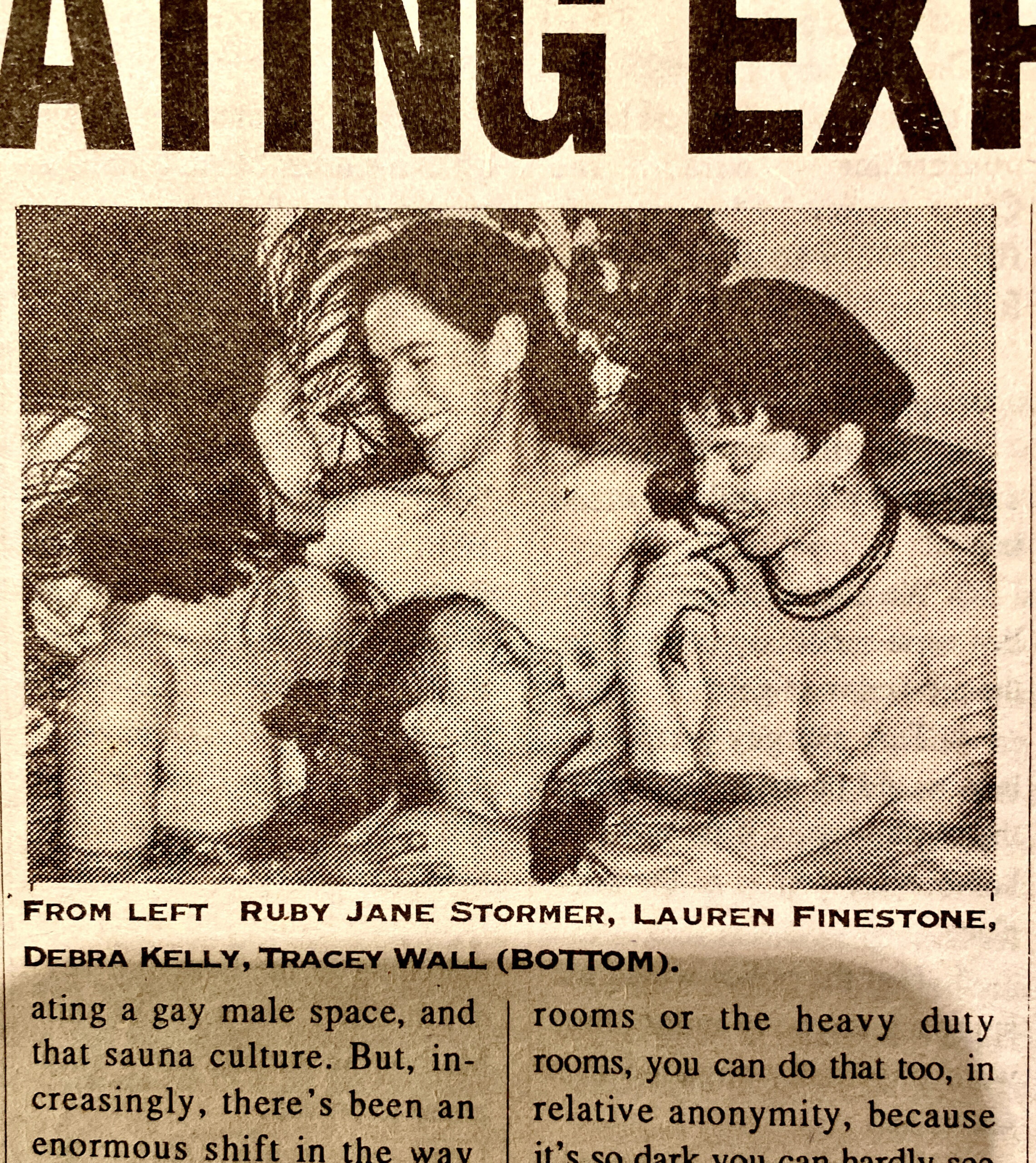
Melbourne Star Observer, circa 1991–1992. Image: Crusader Hillis. Courtesy of Australian Queer Archives (AQuA).
Laura: One of the first things that struck me about Stimulation was the offer of childcare during a sex party. It feels very radical in multiple ways: it subverts the stereotype of mothers as asexual beings (the Madonna-Whore complex), but also challenges the idea that queer people aren’t fit to raise a family (especially at a time when same-sex couples faced significant discrimination and legal barriers around parenting rights). Can you tell us more about the decision to offer childcare at Caviar Club events?
Deborah: Women were often so thrilled that we were offering childcare that they would not come and pick up their children. It would get to like, 3am, and we would be like, “Who even are these children?” Mobile phones hadn’t been invented so we couldn’t contact their parents!
The number on the flyer was my personal phone number, and we hosted the childcare service at my house on Greeves Street. People would call, we’d take their names down, and once there was a minimum of three children then we’d employ childcare workers. Numbers weren’t huge, as there weren’t that many children in the queer community.
Lauren: It was a matter of principle.
Deborah: Once we were threatened with a boycott and a picket line because we had employed male childcare nurses to do the childcare. That was giving money to the patriarchy!
Tracey: Because the guy was a friend of… was he your housemate or a friend of yours, Deborah?
Deborah: He was a friend of my housemate, yeah.
Tracey: Because all the women that we knew wanted to come to the event, so it was sort of by default we ended up with a guy running the childcare for us.
Deborah: I think it was a conscious decision. We thought, Let’s get men to do the childcare because all women should be free to dance! I had been at the Pine Gap women’s protest in 1983, and was inspired that men did all the childcare. The Quaker men of Australia had come and set up a childcare camp.
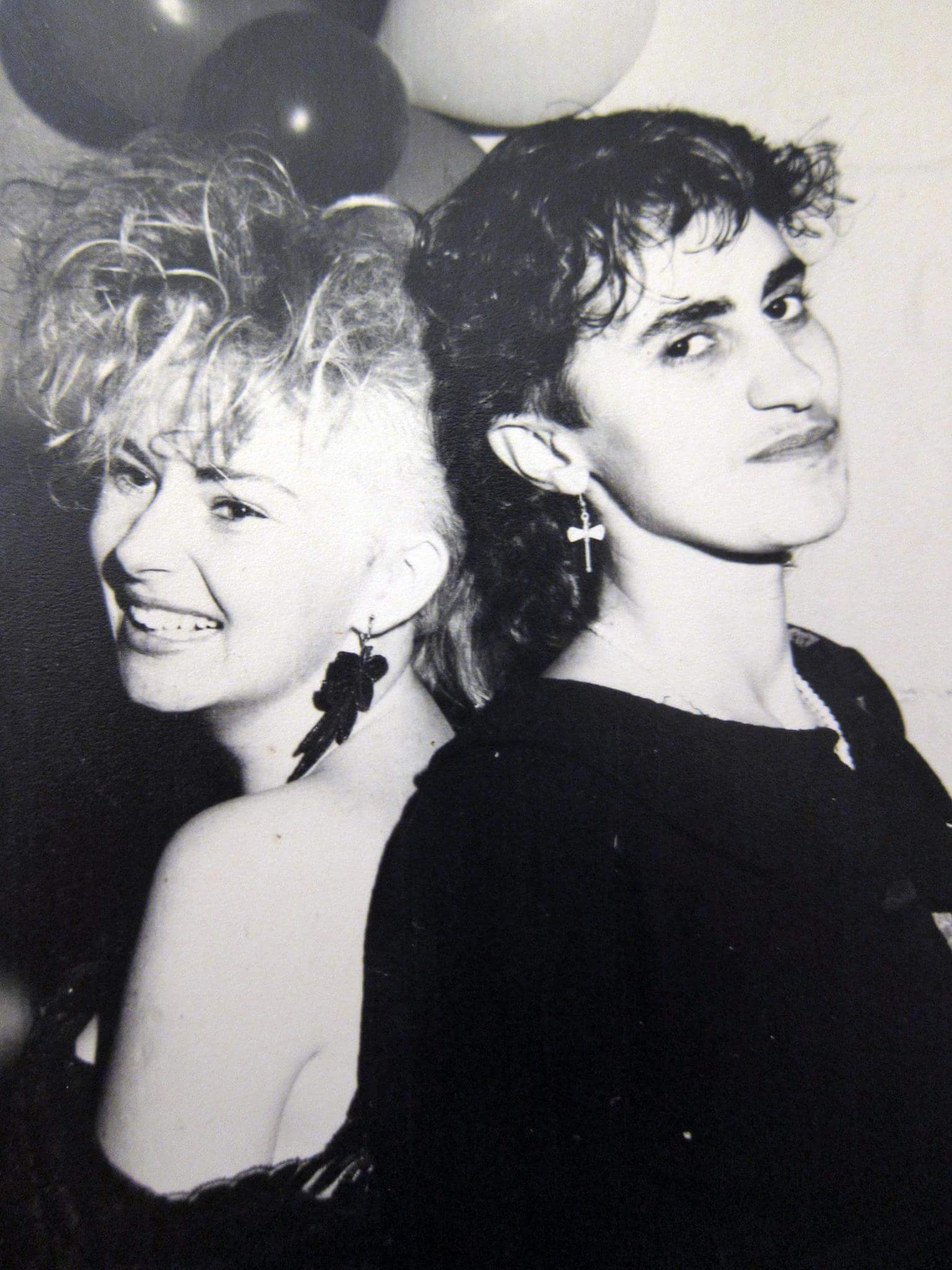
Deborah Kelly and Letizia Mondello DJing at a women’s ball, St Kilda Town Hall, mid-1980s. Photographer unknown. Courtesy of Australian Queer Archives (AQuA).
Laura: How would you like the Stimulation parties to be remembered?
Deborah: I have an anecdote that really sums up the feeling of the parties. I remember being at one of the early Steamworks nights and somebody was DJing, probably Tracey. Anyway, the music was great. I looked out on the dancefloor and there were these two women who looked like separatists from Daylesford dancing completely naked, right next to two young women in thigh-high black boots with little whips and leather masks. I just thought, This is heaven! I thought it was so cool that we were encouraging shamelessness in a community of people who had been brought up really crushed with shame.
Tracey: It was very ephemeral, like, you did have to be there. We didn’t really take photos or document, not to the extent that happens today. In some ways, I regret that we didn’t really have more documentation. On another level, I think the fact that you had to be there is probably why we didn’t censor ourselves that much, because we were safe in the moment, and it only had to be in that moment.
Lauren: That’s very true, Tracey, and at the same time, this interview has made me realise how important these social histories are. We were actually part of something quite special, so thank you, Laura, for capturing that.
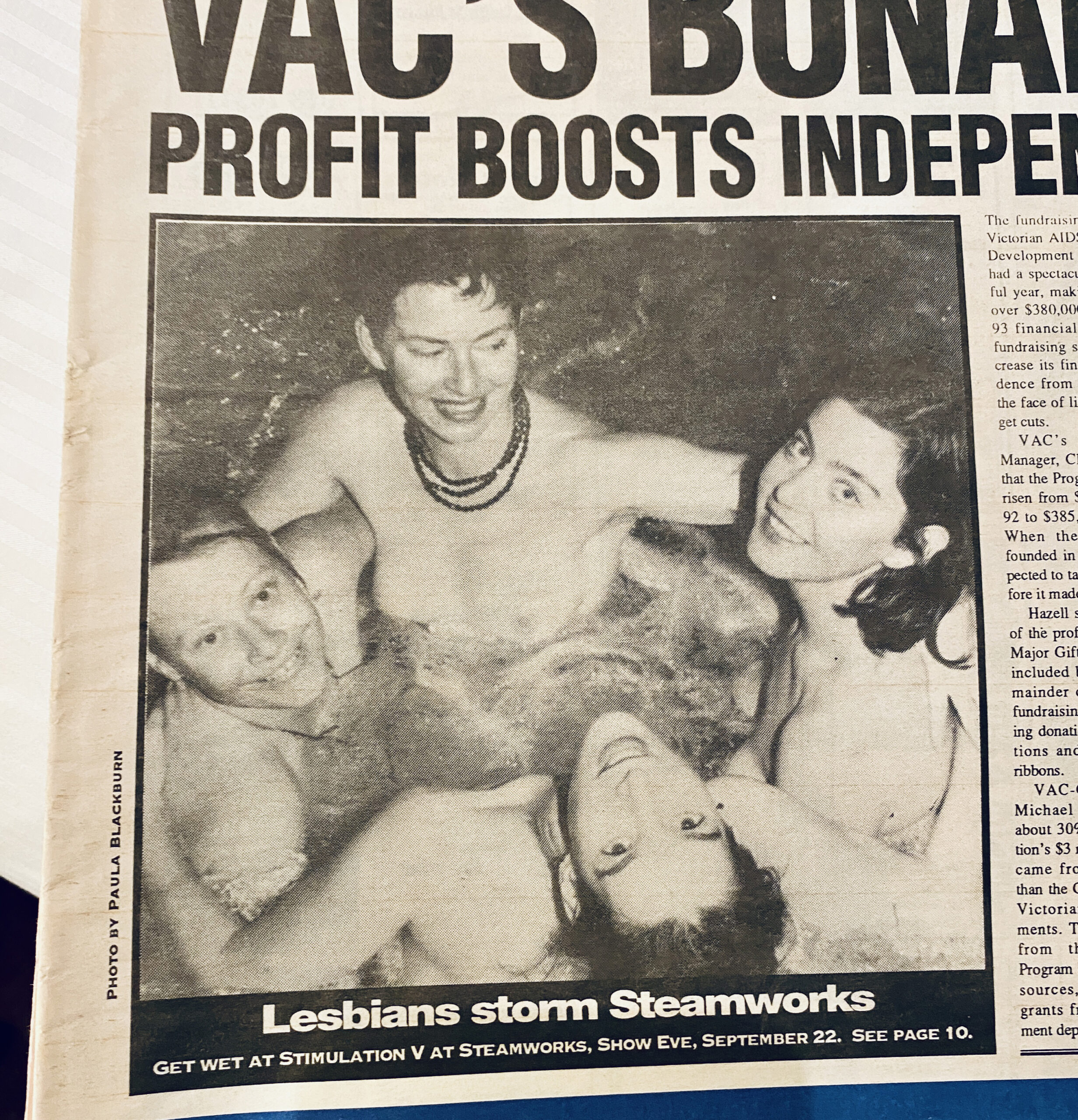
Melbourne Star Observer, circa 1991–1992. Pictured, L-R: Tracey Wall, Deborah Kelly, Lauren Finestone, Ruby Jane Stormer. Image: Paula Blackburn. Courtesy of Australian Queer Archives (AQuA).