

Archer Asks: Author Andy Jackson on crip poetics
By: Alex Creece
Advertisement

Advertisement
Andy Jackson is a poet, essayist, and lecturer in creative writing at the University of Melbourne. His poetry collection Human Looking (Giramondo, 2021) won the ALS Gold Medal and the Prime Minister’s Literary Award for Poetry. Andy’s poems are included in the anthologies Versus Versus: 100 Poems by Deaf, Disabled & Neurodivergent Poets (Bloodaxe, UK, 2025) and Every Place on the Map is Disabled (Northwestern University Press, US, 2026). He is a co-editor of Raging Grace: Australian Writers Speak Out on Disability (Puncher & Wattman, 2024), and he writes and rests on Dja Dja Wurrung country. His latest poetry collection is Askew (Giramondo, 2026).
I spoke to Andy about reckoning with ableism, death and nature in poetry, and his stunning new book, Askew.
Alex Creece: Hey Andy! First off, congratulations on the new book! I really enjoyed my first read and am already excited to read it again. There’s so much to it. I wondered: How does your new collection Askew expand upon, coalesce and/or diverge from your award-winning Human Looking?
Andy Jackson: Thanks, Alex. Well, it’s interesting. Human Looking was such a big project. I spent a lot of time on it, and I was really immersed in fully exploring the huge topic of bodily difference, you know, in all sorts of ways. At the end of it, I think I was exhausted. I kind of wanted to put that stuff away. I felt like I’d almost done everything I could, said everything I could say, in terms of bodily difference.
I really wanted to do something else, but I had no plan with this book. I really didn’t think in advance about what I was going to write.
I purely just responded to what was going on in the world, and how the world reached me in intimate ways, and in broad ways, too. Really, I guess, I was responding to an ambient sense of multiple crises happening at the same time and overlapping. But I was less interested in those things themselves, and more interested in how they affect us as people, as humans, and how do we live together, and live with each other in that space.
So yeah, I can kind of see what the shape of it is looking back, but really it was the least organised book that I’ve ever written. It just happened, you know?
AC: I definitely get that. Honestly, sometimes with poetry, I feel like questions around blurb, synopsis, and so forth, are for marketing purposes only. Like, many poetry collections are responding to their time and context, but then we’ve got to find a way to make it legible to a market, or untangle its themes in retrospect.
AJ: Completely. It was a different approach for me. My last couple of books were very organised, and that organisation helped me. But this time, I had to find other ways of pushing myself forward.
AC: Whether you were conscious of them during the writing process, what questions do you think you were asking or interrogating with this book?
AJ: Mostly in retrospect, the main kind of questions around it were the relationship between bodies that are limited, disabled, different, or in pain, and a world that seems to be in flux, in pain, and in difficulty, as well.
So, I really wasn’t conscious of it at all, but there were always questions in the back of my mind in all different ways: How do we relate to each other? How do we kind of cope with the fact that the world is off-kilter – the ecological world, the social world, and the political world?
AC: Those are interesting questions. They made me think about the essay you wrote with Tim Loveday in the Griffith Review, ‘Is poetry disabled?’. I wonder if the world is effectively disabled, too, in its limitations and its pain. I know you were recently part of an anthology called Every Place on the Map is Disabled, which I haven’t read yet, but feels very apt here, too.
AJ: Yeah. I think that if I’d set an intention to write about these things, it might’ve come across too cerebral or a bit naff. So, I’m glad it was more of an organic process in thinking about relationality.
AC: Next, I wanted to acknowledge that you are one of the country’s most celebrated poets, and perhaps Australia’s most renowned, and visible, openly disabled poet. Can you tell me: What makes poetry such a potent mode of expressing and asserting the disabled bodymind? How does poetic form – and deform – carry the heft of these experiences?
AJ: Thank you, Alex. I feel moved when people reflect on what I’m doing and what my space is in the scene and, I suppose, in the world. So, thank you.
I always feel like poetry is the most intimate literary form there is. I mean, poetry is so broad; I can’t say this about every poem, but I think in general, what poems do is give you an insight into another person’s way of thinking and being. Not just looking from a distance, because the poem often throws you inside it.
For the period of time that you’re reading a poem, you’re inside someone else to some degree. And that someone else is obviously not identical with the poet themselves. There’s something else going on, as well. If a poem itself is about what it’s like to live in a disabled bodymind, then it allows readers the chance to kind of put themselves into that space to realise what is different about their own life, but also maybe what might be similar, or what they might already know about it.
So, I think poetry goes somewhere very deep very quickly, which is always why I keep going back to it. And there are infinite forms, right? So many different possibilities. We, as human beings, have so many different manifestations and variations. The fact that you can open a book of poetry and see a different form, a different shape, a different way of speaking in each poem is, to me, a reflection of the value of all the different kinds of ways of being that are in the world.
Poetry implicitly says, Let’s appreciate difference, and not see it as a disturbance in itself. I mean, disturbance is good as well, and poetry knows there’s a value to that, too.
AC: That’s really lovely. Talking about the intimacy of poetry and kind of getting right into someone’s space… it reminds me of a cold plunge. It’s immersive. And you’re so right about form being like an appreciation of difference. I love that we can just invent new forms, too. I loved ‘Durable and low-cost’ in your book, which is an abecedarian but janked around so it’s not in alphabetical order.
AJ: Totally. Yeah. Like, there’s a couple of poems in there that use forms that were only invented in the last few decades, and have since taken off. Everything’s made up, right? Some things were just made up much longer ago.
AC: Did your Future of Health Fellowship, and the development of Raging Grace, inform the making of Askew? It strikes me that many poems in the collection are alive with conversation, with artists and public figures in history, as well as contemporaries.
AJ: I’d done a few collaborative writing things in the past [before the fellowship], which I quite enjoyed, but didn’t have a huge impact on me. Approaching the Future of Health Fellowship, it seemed like an interesting idea to get a bunch of disabled and neurodivergent people together, to talk and see what happens. Then it absolutely converted me into someone who now strongly feels like poetry benefits from collaboration.
The way that collaboration opens up aspects of your own poetic voice and the way that it takes you into spaces that you don’t expect… it draws things out of you that surprise yourself. Any poem can do that. You can do that by yourself, but there is something about the conversation between poets that feels really liberating and rich. It just holds so much potential.
Since then, I’ve really sought out other collaborations, as well as extracting my own material from it and remixing it. The poem then becomes something else again. In Askew, all the poems are collaborative to a degree. There are only a fraction that aren’t a response to something or someone else.
AC: I’ll ask about this in a little while, but I feel like this ties into the musicality of your work. Collaboration sort of feels like we’re jammin’ together.
AJ: Right? Going into a collaboration can feel like there’s going to be a lot of pressure, or that it’s intimidating to share your work and for them to respond. But in reality, you’re just mucking around, and then suddenly you’ve got a poem!
AC: Warms my heart! In a similar vein to conversation, there is a lot of beautiful, sharp ekphrasis in this collection. I was especially moved by your ‘criptique’ ekphrasis of L.S. Lowry’s painting, The Cripples. Can you share a little about how this piece came about?
AJ: Interestingly, that poem was a commission, which I originally wrote for an anthology on ekphrastic writing [Dancing About Architecture, edited by Oz Hardwick and Cassandra Atherton]. I had to send them a short essay and a poem that responds to an artwork.
I just flipped through a couple of art books we have at home and was like, Ah, that’s right. I’d sort of forgotten about that painting.
I was familiar with Lowry’s work. He was a very down-to-earth and unusual person, who was interested in everyday people. That painting really draws out the fact that, within this industrial heartland of 20th century England, lots of people were visibly disabled.
So, it was fascinating to look at how a viewer or reader might position themselves around that. It took a while to write. Because it was a commission, I didn’t have that intuitive urge; I had to slowly find my way into it.
AC: I’m very impressed! It felt very organic and erudite to me – I had no sense that it was a commission.
AJ: It probably links back to Human Looking; I think it would’ve fit in neatly to that collection. Even though Askew is so different, that poem is a thread that connects to the last book.
AC: From ‘Water, darkening’: “History isn’t history but the eugenic air we pretend we aren’t breathing.”
Your work often subverts ableist depictions of disability in history and folk tales – the disabled person as a mystic, a beggar, a hermit, etc. Do you see this rewriting and excavation of ableist narratives as a form of resistance?
AJ: Yeah, definitely. There’s no other way for me; the only alternative would be to succumb to these narratives and internalise them. So, in order to feel like a genuine, everyday, full person, I need to speak back to that stuff.
Across all my poetry, whether it’s touching on disability or not, I’m wary of rigid presumptions where the surface appearance of something or someone leads to a definite conclusion. Acting as though we know everything shuts down any real possibility of understanding each other.
I’m aware, too, that ableism is not something recent. It’s not something that everyone’s talking about, either. Ableism goes back a long way. It has deep roots. I don’t want to think that one poem can do everything, but again, a poem can allow readers to experience something from the inside, briefly.
I’m also conscious that I don’t want to replace one idea or narrative with another. I don’t want to say, Disabled people are not X, we’re Y. Rather, I want to encourage the realisation that we’re complex and diverse, and that we have a right to privacy and to be ordinary people with depths that others aren’t necessarily entitled to. That’s another thing that I interrogate in my work – the invasive curiosity that people sometimes have about disabled people.
AC: These things are so pervasive; once you start untangling, there’s always more to untangle. Sometimes writing a poem can help me process a particular emotion or experience, but it doesn’t resolve it. There’s a positive feedback loop, where the more it itches, the more we must pick at it, and then it itches some more.
This is perhaps a silly example, but it makes me think about the volume of positive media out there depicting P.T. Barnum – who exploited disabled people in his sideshow circus, was virulently racist, and boiled whales alive – as some kind of whimsical dreamer. A doco came out in recent years by a disabled filmmaker, fighting the ableist legacy of Barnum, which is great, but as you said, these legacies have deep roots. We can’t just write one poem or make one artwork and be done with it. The conversation continues.
AJ: Exactly. And even when we make some progress in, for example, visibility and having our own stories told, we’re not necessarily escaping that spectacular aspect – you know, being a spectacle. We carry that stuff around, and as things shift, we have to keep going back to it, pointing it out and finding ways to change that dynamic. So, it’s a long, long, long struggle.
AC: Askew is a very musical collection, with lots of references to songs and hymns, and ‘aftersongs’ written in tribute to people who have died. I would say that this is a bit of a through line in your work, going back to your 2017 book Music Our Bodies Can’t Hold, featuring poetic portraits of other people with Marfan Syndrome. Why do you think music is such a powerful motif, particularly in expressing utterances and gestures of the body?
AJ: I haven’t really thought deeply about it, though I’m conscious of it. Music is one of those things that I find myself referencing almost subconsciously, and being drawn towards. Music does play a big role in my writing. I find it helps me write to have music in the background, and I try to find the right music to suit the sort of writing that I’m wanting to pursue at that time.
Just like poetry, music is really varied. It’s not something that is just beautiful – it can also be something that makes you question things, it can disturb you, it can stimulate and excite you.
I think probably the main reason I’m drawn to music, or that I use it as a kind of motif, is that it’s powerful beyond reason or argument. You don’t usually approach music from an intellectual standpoint – you’re enveloped and consumed by it, and it changes you. It takes you out of yourself on some level, but also pushes you deeper into pondering things that are under the surface.
When you walk into a room and there’s music, if you’re at a gig or whatever, everyone is there together, having shared and separate experiences at the same time. Like poetry, it can draw us together on an emotive level, while still having our unique individual experiences.
AC: Thinking about going to gigs, being in mosh pits or dancing at clubs, I often feel that this is one of the socially acceptable ways in which people can publicly stim. To be responsive to the body in an instinctive way, without self-judgement.
AJ: Exactly. And many different ways of dancing are appreciated, too. If you dance in an unorthodox way, it’s great, no problem!
AC: For sure! It’s about how it feels, not how it looks externally.
Changing tack, I wanted to highlight this gorgeous quote from ‘A species of future’: “Marfan may be a genetic baton, but it has always been my bones, my very material. I am here because it is determined to be part of the human story.”
Time for a goth question. How does the spectre of death contribute to your creative process?
AJ: This is another one of those things that has always been there, right? Like, in the work and in my consciousness, but not overtly, necessarily. When I look back on my life, I realise that I was born into a sense of mortality and vulnerability. My dad died when I was two, and he had the same genetic condition. So, I grew up with that knowledge before I could really form memories.
So, I’ve long been aware that my own life was kind of constrained, and the future was uncertain. To refer to that quote, too, my existence is one of many possibilities of what can happen with bodies. I think I’ve always had this sense that anything can happen, and that the future might be foreshortened and limited. That has all sorts of kind of downsides. Obviously, it can be really disheartening and depressing, and it can stop you from planning things. But the other part of that is that it can allow you to reckon with the fact of limitation, which all of us have to reckon with sooner or later.
Whatever our bodies go through, whatever our mind goes through, we all have limits, and sometimes they really press up against us. If you don’t reckon with it sooner, then you’re going to have to reckon with it later.
Askew reckons with this in a different way than my other books have. But again, like you said with the spectacle of disability, we do have to keep reckoning. It’s not something you solve and then it goes away. In the last few years, I’ve had friends die, and it’s always a shock. It changes your whole world, every time. You have to ask, How do I rebuild the world without this person in it, but still keep them alive on some level?
AC: How do you think death and hope sit alongside each other an increasingly precarious world?
AJ: I have to say I don’t know, but the not-knowing is important. All I know is that those two things are non-negotiable. Obviously death is inevitable, but whoever said “life wants to live” was also correct – and that’s hope. Each person, ecosystem and species has a forward momentum. So, both of those things must co-exist. How they co-exist? Who knows. We have to come up with a million different ways of living through life.
AC: Hmm, and I do feel that poetry and artmaking are both ways in which we cope with the inevitability of death, the preciousness of life, and the precarity of hope. The spectre of death definitely informs my practice, too.
AJ: I think for everything I write, and maybe this is true for you as well, I write because I need to. The thing itself is a knot of different stuff that you need to pull at and try to disentangle or at least just express on some level. It’s not just an experiment. It’s not just fun, although it can be all those things, too. It’s something necessary. And I feel that when I read a poem from someone who’s doing that necessary work, it’s like, Ah, such a relief.
AC: Absolutely. I used to be afraid of like, What if I can never write another poem? But, on reflection, I think it’s more that I’m grappling with the fact that I’m eventually going to die, likely with things left to explore and poetic impulses yet to fulfil. But the poems will continue.
Anyway, thank you for that discussion of a somewhat heavy topic! I have another green witchy question: Natural elements are breathing and heart-beating in this collection. Reading Askew, I interpreted the whims of nature as a recurring destabiliser of normativity, the normative body. Air, cloud, rock, and smoke demand that we adapt to their conditions, and literally weather us. Was this an intentional choice? How do you interpret nature’s role in your poetry?
AJ: I love this question because again, it’s made me think about things from a different angle than I would intuitively think about it.
Living in regional Victoria, in the Goldfields area on Dja Dja Wurrung Country, a lot of the landscape has been ruined in some way by mining, being churned upside-down, especially at the time of the gold rush. It’s starting to find another shape, which is incredibly potent and beautiful, and remains alive and strong. I identify here both with its struggle and its persistence.
So, I guess when I’m feeling a bit lost inside my own head or feeling like a bit alone or off-kilter, being in the environment grounds me. So, it’s actually often a stabilising force in my life. The land reminds me, This is what we are; this is what we belong to.
A lot of my poems come from a desire to not be lost inside the maelstrom of human culture, and to be involved in something that has a much different sense of time and space. But as you say, the opposite is also true: nature is a destabilising, risky and at-risk place. It challenges people to return to the nature of life being in flux, being at the mercy of its elements. Life and death all wound up together – all the things that we know pretty intimately as disabled people, but some people don’t, or don’t want to know.
To be confronted with the natural world, particularly in the climate crisis era when disasters are happening so often, that’s a reminder of the human world and a reminder of our place within nature and its destruction.
AC: You’re so right about nature being both stabilising and destabilising, strong yet sick. Thinking about strength and vulnerability, I wanted to ask: What does this book grapple with in terms of masculinity in 2026? How does your work speak to the way men engage in community care (thinking about ‘Carrier’, which deals with masking to prevent the spread of covid) and self care (‘Altermath’, in its theme of suicidality)?
AJ: I think the theme of masculinity has become larger in my writing as time has gone on, for all sorts of reasons.
I’m looking at it from the outside and the inside at the same time. I observe the people who roughly conform to the expected traits of masculinity, and I’m kind of mystified and intrigued. I’m troubled by so much of what’s happening online and in people’s lives. But I also write about masculinity from the inside. I am a man, so I carry some of those typical traits around with me, too.
I’m very interested in men’s fear of being vulnerable, our fear of being in relationship with other people. Not in a relationship, but in relationship: knowing that we affect each other, and we are in this web together. Askew tries to dig into what men are afraid of – the fear of not being in charge and actually being subject to the wider world. Again, this is something with deep roots and a long history that can’t just be switched off, so it needs to be continually excavated and transformed.
AC: I imagine there would be an intersection, too, in the impact of disability on experiences of masculinity. There’s an interesting tension between, as you said, men’s fear of vulnerability and the fact that disability inherently points to a vulnerability.
AJ: Completely, and we can see that play out in some of the myths and narratives around disability, the way that some experiences or presentations of disability are more accepted than others.
AC: To finish up: In your opinion, can poetry be a way of cultivating tenderness? Or do you think that people who seek out poetry are those who are already attempting to do this?
AJ: Look… it comes back to the question: What can poetry do in the world?
Poetry doesn’t stop wars. It doesn’t pull bullets out of guns or soften the heart of a person who isn’t already headed that way. But I do think it can validate someone who has that inclination towards tenderness. Whether they’re already practiced in being vulnerable, tender and open, or if they’re simply curious, poetry gives us permission to go further into that, and be human together – vulnerable and connected.
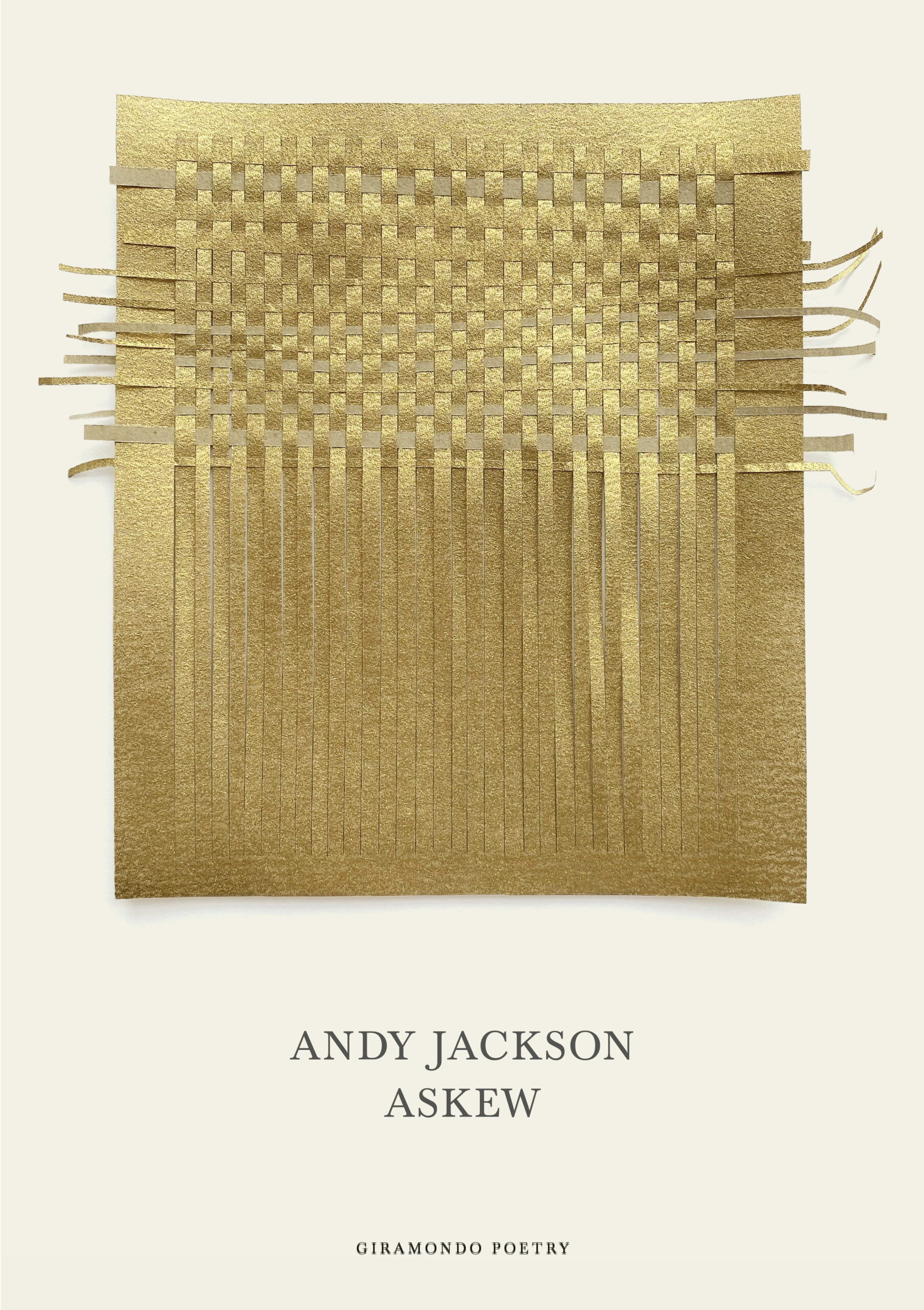
You can buy Askew by Andy Jackson on the Giramondo Publishing website, or at your local independent bookstore.