


Queer eroticism in Catholic iconography
By: Emma Cieslik

Advertisement
On Good Friday last year, Vulture music critic Craig Jenkins interviewed Sufjan Stevens, an indie musician whose music itself is intimate in both a religious and sexual sense.
Although the interview covered Stevens’ recent albums and tours, many media outlets latched onto what he said about his songs ‘John My Beloved’ and ‘To be Alone with You’ – specifically, about the closeness of two Biblical figures Jonathan and David.
“The Bible’s very gay. Just all men. That’s what you get when there’s a patriarchy that’s endured for so long. Jesus was single, never married.”
As Stevens explained, physical intimacy is at the heart of his relationship with God through the Catholic sacraments, just as eroticism sits at the centre of Catholic art grappling with spiritual experiences within a human body.
“You’re literally eating the flesh and drinking the blood of God during the Eucharist. It doesn’t get much more erotic than that.”
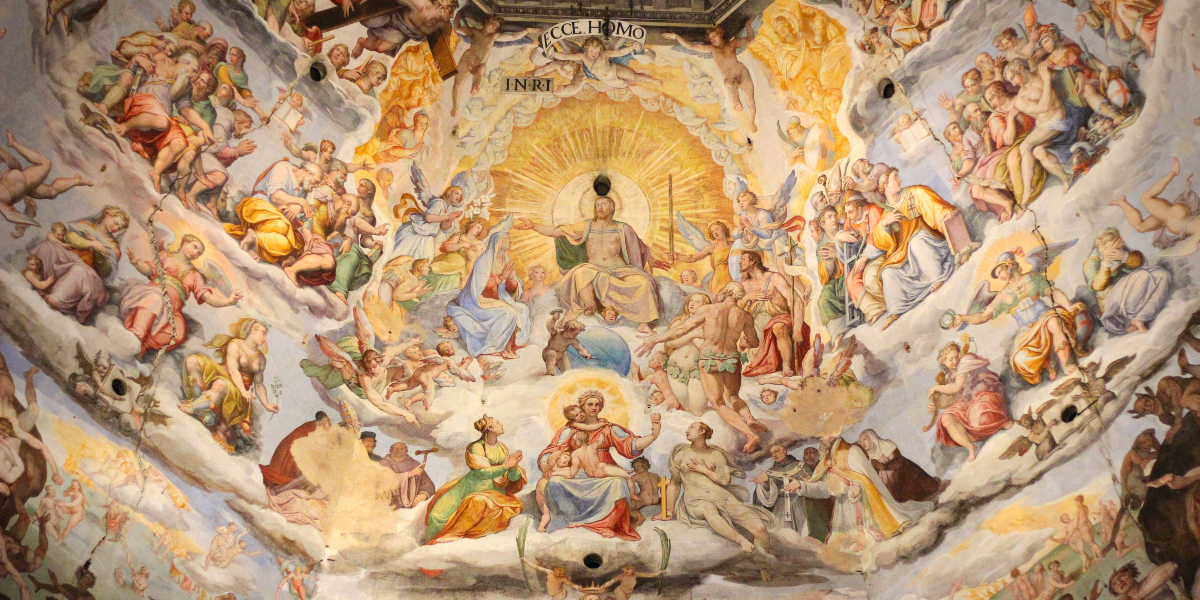
Image by: Lorenzo Turroni
As someone raised in Catholic queerphobic purity culture, I appreciate Stevens’ shoutout to a rich history of Catholic art that opposes sexual purity ethics as historical.
In fact, he is one of many queer people who are exploring sexually charged Catholic iconography as a conduit to understand and affirm queer attraction and spiritual sensation.
Last February, Mexican artist Fabián Cháirez’s exhibition La venida del Señor (The Coming of the Lord) featured paintings depicting ordained priests and nuns in intimate or suggestive poses. In the series of nine paintings, nuns penetrated interfolding robes not-so-subtly representing vulvas, while priests licked Christ’s feet nailed to the cross.
The exhibition received considerable backlash in Mexico, which Cháirez explained was the direct result of a homophobic Christian morality code, not a misunderstanding of Catholic art history. Similar to Stevens, Cháirez said that this art was “an exercise in which I made a comparison between religious ecstasy and sexual ecstasy, two things that would appear to be opposites but actually have more in common.”
Despite receiving intense pushback for featuring ordained clergy in homoerotic poses, Cháirez’s art speaks to a rich history of how sexual arousal was used by Catholic artists and writers alike to denote spiritual ecstasy.
In much the same way, other queer artists – even if they were raised Catholic but do not identify as Catholic presently – are also grappling with the queer possibilities of Catholic art. Even artists who were not raised Catholic have explored how Christianity’s hegemonic influence affects the way they perceive and express themselves.
Isabella Greenwood’s recent exhibition, God Willing, explores “how we can reclaim [religious] symbology in a way that still lends itself to the weight of religious trauma, while reimagining it through a fun, fleshy, and maybe even camp lens.”
Greenwood is not alone – a number of young people are tattooing Catholic symbols onto their body as part of an aesthetic-driven exploration of faith.
Queer people who have been routinely denied access to and excluded from Catholic iconography reclaim it by literally injecting into their bodies, combatting gatekeeping with queer eroticism that acknowledges and celebrates the rich history of queer Catholic eroticism.
For every queer Catholic kid raised to believe that other queer and trans people do not exist in the present, much less in the history of our Church, Catholic art history is a path of gender and sexual liberation.
The examples are extensive: David and Jonathan’s close relationship, as explored by Stevens and others; the not-so-subtle homoerotic imagery of Saint Sebastian; Jesus’s own side wound painted as an almond-shaped mandorla, strikingly similar to a vulva, which can be seen as a queering of his body.
In some depictions, the blood from Jesus’s wound is even collected in a goblet to feed his disciples, similar to how the Mother of God sprays her breast milk into the mouth of a saint in Alonzo Cano’s The Lactation of St. Bernard (1650).
Female saints have a history of eroticism, too.
For Saint Teresa of Avila, God’s love became so intense that she moaned – as immortalised in Gian Lorenzo Bernini’s The Ecstasy of Saint Teresa (1652). Saint Hildegard von Bingen was one of the first in the Western world to write about orgasms; she conflates love with pain and the female body as erotic and holy in ways that are pointedly sapphic.
Even for cis, straight Catholic women – and Christian women more broadly – art and writing that affirms the legitimacy of women’s sexuality can be liberatory. It destabilises the idea that women’s sexuality is by its very nature pornographic and explicit.
As someone raised to believe that her attractions to women were sinful, it was incredibly impactful to learn that sexuality was a key tool to conceptualise what spiritual enlightenment may feel like within the body.
In contrast to Gnosticism – which views the human body as a stumbling block for the spirit – Catholic art traditions implicitly situate spiritual triumph in a sexually charged body.
On one hand, this conflation of virilism with spirituality can be problematic. It can reinforce heteronormativity and deny the existence and importance of asexual and aromantic individuals within the Church.
But for those who have felt alienated by their childhood churches, centring a Catholic faith in our own bodies – and thus affirming that our bodies as divine and our love holy – can be a practice in queer liberation.
For this reason, Stevens’ comments were especially important coming from a queer person raised in the Catholic Church – an institution that continues to deny the existence of trans, non-binary and intersex people and consider any sexual intimacy outside of marriage, especially for queer people, a sin.
Catholic eroticism views physical intimacy as the closest paradigm to spiritual intimacy, and as a result, is featured in some of what the Church considers its most holy spaces.
Despite the assumption (sometimes reinforced by the Church) that Catholicism shames the sexual body, sexuality and spirituality are entwined in its iconography. Queer and trans identities are embodied within the theological ancestries of Catholicism, depicting sexuality as inherently human and sanctifying.
Queer Catholic artwork is a reclamation, necessitating the sanctity of erotica, including the queer erotica, as a language of spirituality.